
Building Itanagar's First Business Enablement Hub: A Market-Entry Blueprint for MyBranch's Coworking Model
Published: 04 July 2026
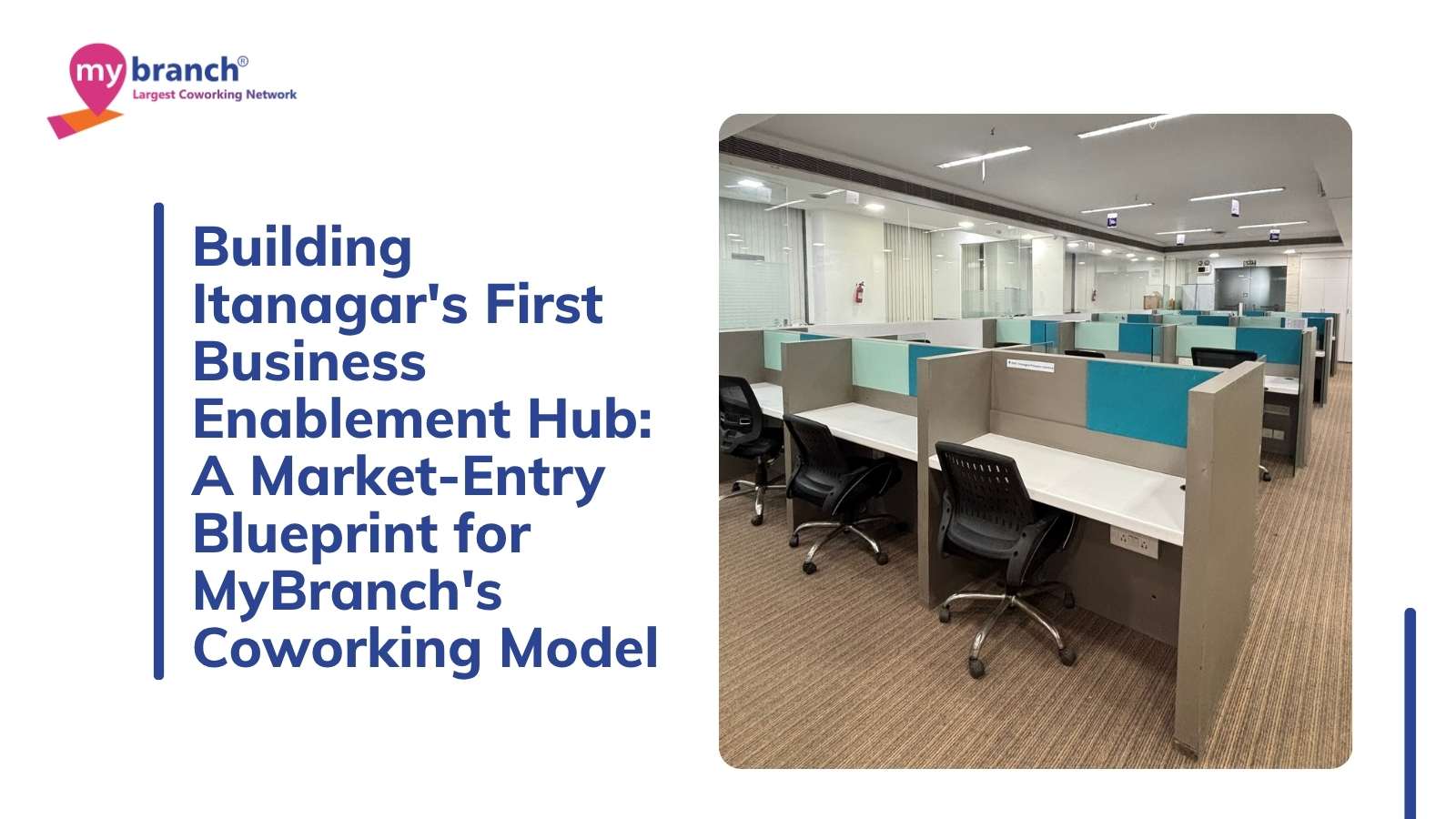
This document outlines MyBranch's proposed approach to launching a coworking / managed-office model in Itanagar, Arunachal Pradesh, based on current market analysis. It is a forward-looking entry plan, not a record of a completed engagement.
Target Client Profile: Who Needs This, and Why
Itanagar's economy is administrative and service-led rather than industrial, which shapes a very specific demand profile for flexible workspace. The clients most likely to need a coworking/managed-office solution here fall into a few clear categories:
Government vendors, contractors, and consultants. As the state capital, Itanagar sees constant short-term engagement from PSUs, departments, audit firms, and development agencies — entities that need a professional address and meeting space for the duration of a contract or project, without committing to a multi-year lease.
Startups and MSMEs. With the proposed ARUN MSME Mission targeting 500 micro and small enterprises a year, and the Arunachal Pradesh Startup Manch doubling startup intake to 100 annually, a wave of early-stage businesses will need low-cost, flexible space, GST/company registration support, and basic business infrastructure they can't justify building in-house.
Travelling project and corporate teams. Improved access via Donyi Polo Airport, plus the planned aerocity, means more outstation teams will be passing through or stationed temporarily in Itanagar; exactly the use case coworking and virtual-office products are built for.
Bamboo, cane, handicraft, and tourism enterprises. With the new Bamboo & Cane Technology Centre at Gungu and the state's ODOP/GI push, artisans, SHGs, designers, and export-support businesses need access to e-commerce, photography, and product-display infrastructure they wouldn't otherwise have.
In short: these are organizations that need credibility, compliance support, and operational infrastructure on a flexible footing; not large floor plates or long-term capital commitments. That gap, combined with thin organized coworking supply in the market today, is what makes Itanagar a viable entry point for MyBranch's model.
Market Context
Itanagar is not an industrial city in the mould of Guwahati, Silchar, Dibrugarh, or Dimapur. Its economic identity is built around administration, government contracting, services, education, tourism, and an emerging startup ecosystem. Arunachal Pradesh's industrial base remains overwhelmingly MSME-led: of 18,165 registered industrial units statewide, only 5 are large scale, while 18,125 are micro and small enterprises. The two industrial estates closest to the capital, Chandranagar and Naharlagun, are small and show no vacant open space for expansion.
This profile points away from large factory-floor or corporate-campus office demand and toward a different buyer set: government vendors and contractors, consultants, NGOs, audit and legal firms, banking/insurance/IT service teams, training providers, and a growing population of startups and MSMEs.
Why MyBranch Identified Itanagar as a Target Market
Government and project economy. As the state capital, Itanagar hosts departments, PSUs, contractors, and development agencies that regularly need short-term office and meeting space rather than long-term leased premises.
Startup and MSME momentum. The state's 2026–27 budget proposes the ARUN MSME Mission, targeting support for 500 micro and small enterprises annually, alongside the Arunachal Pradesh Startup Manch, which doubles startup intake from 50 to 100 per year under Entrepreneurship Development Programme 4.0.
Improving connectivity. Donyi Polo Airport has strengthened access to the capital region, with an aerocity planned nearby and monorail/ropeway feasibility under review for the twin-capital corridor.
Low-organized supply. Searchable coworking inventory is thin - a handful of listings across Sector A, Naharlagun, and small-format providers - indicating an early-stage market rather than a saturated one.
MyBranch's Proposed Entry Model
Rather than launching a large metro-style coworking center, MyBranch's approach for Itanagar is sized precisely for the market: a single, well-curated 2,000 sq ft center, phased into operation as occupancy builds.
Within the 2,000 sq ft footprint, the proposed layout allocates approximately 400 sq ft to common areas (reception, café/pantry, corridors), 300 sq ft to a meeting room and training/event room, and the remaining ~1,300 sq ft to productive workspace yielding:
Phase 1 (Market Testing): 25–30 seats, 5–6 private cabins, 12–15 flex/fixed desks, 1 meeting room (6-seater), 1 training/event room (10–12-person capacity), and virtual-office/registered-office services.
Phase 2 (Densification): 35–40 seats Achieved by converting part of the training room into additional desk capacity or adding a second cabin row; triggered only after Phase 1 sustains 60–70% occupancy for three consecutive months.
MyBranch would not attempt a larger footprint at launch. The 2,000 sq ft model is intentionally lean: lower fixed cost, faster break even, and a natural forcing function to validate demand before committing to a larger premises.
Site Selection Criteria
Consistent with MyBranch's standard property evaluation discipline, candidate locations would be assessed along the Itanagar–Naharlagun corridor, prioritizing:
· Niti Vihar/APIIP and the Secretariat/Assembly side for government and institutional proximity
· Sector A/Chandranagar and Naharlagun for service-sector and MSME density
· NH-415–adjacent sites for accessibility, balanced against the corridor's traffic and disruption risk
For industrial and service users specifically, proximity to Naharlagun, Chandranagar, and Banderdewa would matter more than a premium city-centre address.
Facility Design: Business Enablement, Not Just Desks
MyBranch's proposed facility brief goes beyond standard coworking amenities to reflect the realities of the local client base:
Core infrastructure: reliable power backup, dual internet connectivity, parking, secure access, meeting rooms, GST/company registration support, virtual office services, printing/scanning, a small event room, a training room, and a café/pantry.
Differentiated, high-value add-ons: a tender-support desk, government liaison support, CA/legal/IPR assistance, startup mentoring, an e-commerce/photo/video room for handicraft and tourism sellers, a small product-display area, and weekend workshops; positioning the center as a hub for Arunachal's bamboo, cane, handicraft, and tourism economy as much as for conventional office tenants.
Key Risks & Mitigations
Risk 1: Regulatory complexity for visiting and non-local staff
Issue: Non-Arunachali staff and visiting project teams require Inner Line Permit (ILP) compliance, which is actively enforced in the Itanagar Capital Region.
Mitigation: MyBranch would build ILP guidance and documentation support directly into the onboarding process for corporate and project-team clients, reducing friction for outstation tenants.
Risk 2: Thin anchor-tenant base at launch
Issue: With limited organized coworking supply and a service-sector-led economy, early occupancy depends heavily on government and startup ecosystem activity rather than broad corporate demand.
Mitigation: MyBranch's phased model ties expansion to proven occupancy, and the go-to-market plan prioritizes 2–3 anchor clients drawn from government vendors, PSU teams, or APIIP/STPI-linked startups before committing to Phase 2 scale.
Projected Outlook
Statewide, Arunachal Pradesh's GSDP at constant prices was estimated to grow 10% in 2025–26, with services contributing 52% of the economy; a structural tailwind for service-office demand. For coworking specifically, the one-year outlook is positive but niche: a well-located, professionally run 25–30 seat center within a 2,000 sq ft footprint is viable, particularly if positioned around startups, MSMEs, government vendors, and travelling project teams.
The principal risks to this thesis are low corporate density, road and traffic disruptions along NH-415, a still-developing premium office culture, price sensitivity, and dependence on continued government and startup ecosystem activity.
_______________________________________________________________________________________________________________________________________________________________
Itanagar offers limited heavy industry but strong emerging demand for flexible, well-supported business space. MyBranch's model for the market is a small-to-mid-size business enablement hub rather than a large corporate coworking campus: start lean, secure 2–3 anchor clients, lead with virtual-office and meeting-room products, and build partnerships with APIIP, STPI, MSME bodies, tourism/handicraft networks, and government vendors.
This blueprint reflects market analysis as of mid-2026 and is intended to inform MyBranch's go/no-go decision and entry sequencing for Itanagar.