
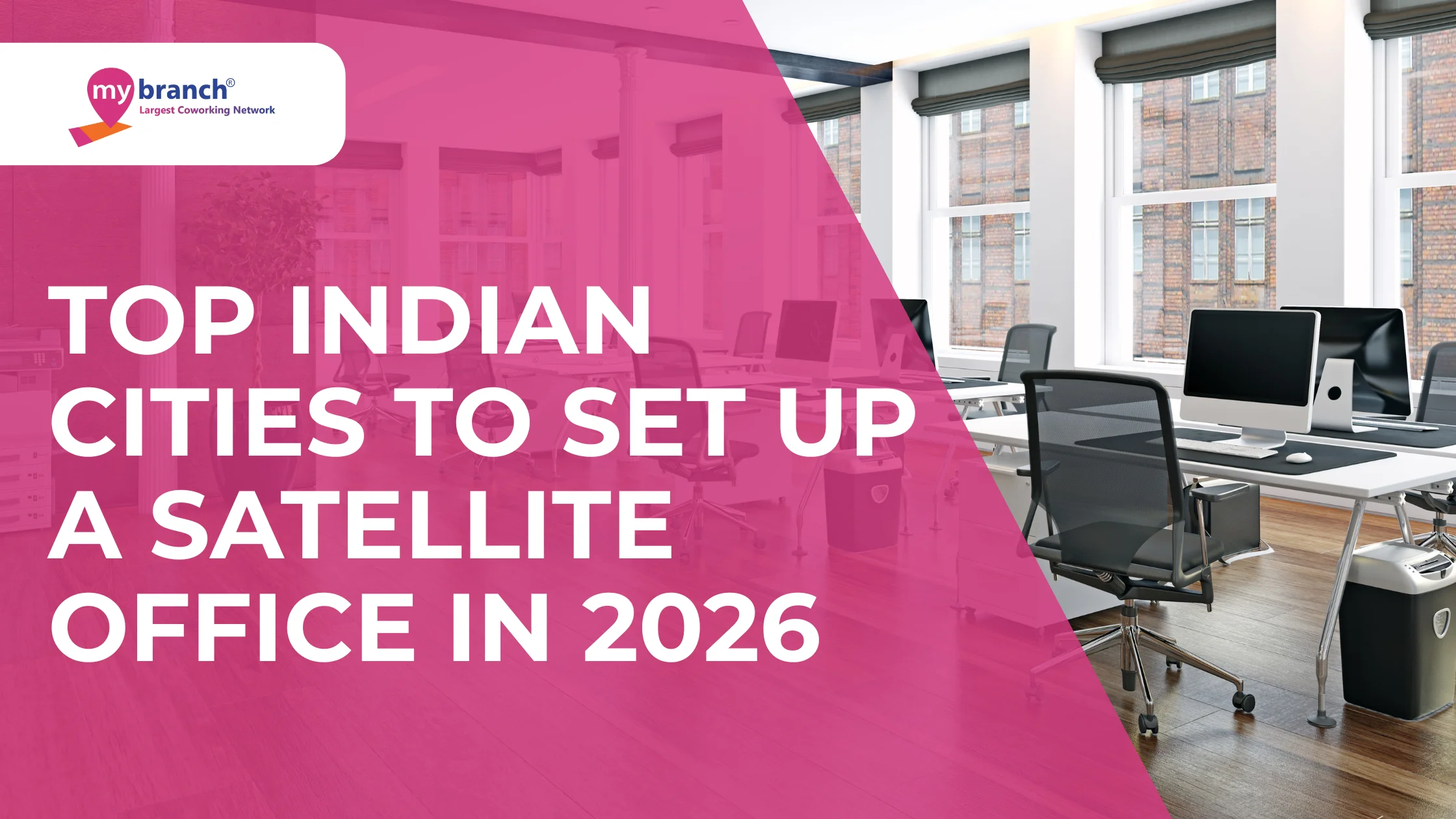
If 2020–2022 was about "Can we work remotely at all?", the 2025–2027 question is sharper: Where should our next 20–200 people actually sit?
Expanding in major metropolitan areas is becoming costly, with Central Bengaluru, Mumbai, and parts of the NCR commanding high rental rates due to competition from Global Capability Centres and large tech companies. Flexible and coworking workspaces now account for about 14–20% of India's annual office leasing and are growing as businesses favour agile, low-capital-expenditure solutions.
For companies planning a satellite office in India in 2026, the question is no longer "metro vs Tier-2." It's:
- Which city + micro-market gives us the talent we need,
- At a rational cost,
- In a flex / managed office format that doesn't lock us into a five-year mistake?
From Qdesq's vantage point in the flex and managed office ecosystem, here are eight practical, high-signal satellite office locations in India you should consider.
- Bengaluru (Periphery, Not CBD)
Bengaluru remains a leading choice for tech and GCC expansions. However, in 2026, satellite offices should be located along the Outer Ring Road, Whitefield, North Bengaluru, or in the Bellandur corridors, rather than on MG Road or in Koramangala.:
- You get immediate access to a dense pool of engineering and product talent.
- Coworking and managed office operators are expanding aggressively along ORR, Bellandur and North Bengaluru.
- The metro build-out gradually takes pressure off the worst commutes.
Best use-case for a Bengaluru satellite office:
High-skill but focused teams – product pods, AI/ML units, SRE, QA, and premium customer support that needs to sit close to tech.
How to use flex smartly in Bangalore:
Instead of signing a large, fixed lease, anchor a 50–100-seat managed office in Bangalore inside a flex centre near the talent you want. You keep cost flexibility, and you're not stuck when hiring plans inevitably change.
- Hyderabad
Hyderabad is the one city that keeps showing up in serious expansion discussions because it rarely forces trade-offs.
- HITEC City, Gachibowli and the Financial District host a deep mix of IT, BFSI, pharma, and GCC tenants.
- Rentals in many sub-markets are still competitive compared to the most expensive Bengaluru and Mumbai corridors.
- A mature GCC ecosystem means mid–senior talent is easier to find than in many Tier-2 bets.
On top of that, the Coworking space in Hyderabad has grown strongly, making it easy to start with two seats and grow to 200 without changing cities.
Best use-case:
Suppose you want a "true" secondary hub, not just a back office. In that case, Hyderabad is where you build your GCC-style satellite office in India: data teams, shared services, product engineering, and transformation pods.
- Pune
Pune is the opposite of flashy. And that's exactly why it works so well as a satellite office location.
- Hinjawadi, Baner, Kharadi and Aundh are now mature tech and GCC corridors, not experiments.
- The city has a stable pipeline of engineering and management graduates feeding IT, automotive, SaaS and research teams.
- Many companies report lower attrition here compared to "headline" metros, which compounds into better productivity over 3–5 years.
Best use-case:
Product engineering, design, R&D, L2/L3 support, and cross-functional pods that need both focus and continuity.
Flex spaces in Pune:
Pune thrives by blending a small managed office for core teams with coworking seats for contractors. This hybrid approach significantly boosts the city's long-term performance.
- Chennai
Chennai may not always trend on LinkedIn, but its leasing numbers reveal a vibrant market. The established IT corridor along OMR, along with Guindy and emerging micro-markets, supports a diverse office ecosystem for technology, BFSI, and engineering.
The city has distinct advantages for satellite offices:
- A strong SaaS and product heritage – helpful if you build recurring-revenue software or platform businesses.
- A workforce that tends to do well in documented, process-driven roles.
- Good airport connectivity for leadership travel, with more Grade-A flex inventory now than a few years ago.
Best use-case:
SaaS and product support centres, QA hubs, implementation teams, and stable DevOps pods.
How coworking spaces in Chennai help:
Many companies are choosing managed offices in coworking spaces, utilising 50–150 seats to add project bays, training rooms, or conference rooms, rather than committing to large traditional leases on OMR.
- Ahmedabad
When cost discipline, compliance and predictability matter more than "cool address value," Ahmedabad deserves a serious look.
- SG Highway, Thaltej, Bodakdev, and nearby corridors now offer modern Grade-A buildings at rental rates far lower than those in top-tier CBDs.
- Gujarat's business-friendly environment often translates into smoother local compliance and approvals.
- Proximity to manufacturing and industrial zones makes it ideal for ops, finance and regional coordination.
Best use-case:
BFSI back office, finance and reconciliation teams, regional sales enablement, supply-chain ops, and early engineering or analytics pods that support western India.
Flex Angle in Ahmedabad:
This city is ideal for a plug-and-play branch office with MyBranch-style centres: fixed-seat costs, simple compliance, and the ability to add satellite teams as your West region grows.
- Jaipur
Jaipur is changing from a "tourist city" into an emerging office market in India, a shift often overlooked. Micro-markets like Mansarovar, Vaishali Nagar, and Sitapura are seeing growth in coworking spaces and Grade-A projects aimed at the IT and professional services sectors.
Here's what Jaipur offers:
- A steady pipeline of junior talent from engineering, management and design colleges.
- Significantly lower office rentals compared to Delhi, Gurugram or Noida.
- Fast highway connectivity to NCR, which keeps leadership and client travel simple.
Best use-case:
Inside sales, customer support (voice + non-voice), design and content teams, HR operations, and early-stage engineering or QA pods.
Why 2026 is a good entry year:
Flex operators are currently expanding, allowing negotiation for satellite office setups that include branding, meeting rooms, and even small studios without the need to commit to a long-term lease from Day 1.
- Kochi
Kochi is the classic "under-the-radar" pick that founders only discover when they meet someone who has actually built a team there.
- Infopark and SmartCity offer modern IT campuses that already host global and domestic IT/ITeS tenants.
- Talent is strong in support, digital marketing, analytics, and development.
- Lifestyle and cost of living drive better retention compared to some high-pressure metros.
Best use-case:
Customer support centres, digital operations, marketing ops, analytics pods, and remote-first squads that don't need daily HQ access.
Kochi Flex Spaces:
Kochi is ideal for a hub-and-spoke coworking strategy: a 30–50 seat core team in a managed office, with overflow handled through day passes and flex seats across multiple centres.
- Nagpur
Nagpur is not going to become "the next Bengaluru" – and it doesn't need to. Its strength lies in central geography and logistics infrastructure.
- The MIHAN initiative and its infrastructure, though slower than expected, still support logistics and warehousing growth.
- You get lower commercial rentals compared to most Tier-1s
- It's a natural base for companies that need pan-India coordination for distribution, logistics or on-ground sales.
Best use-case:
Logistics control centres, dispatch and routing, nationwide customer operations, regional sales hubs, and blended ops + tech teams.
How a satellite office setup works here:
You don't need a large signature campus. A compact, efficient managed office in a well-connected part of the city—with potential for training rooms and 24/7 support shifts—is usually sufficient.
How to Choose Your Satellite Office City
Before you fall in love with any city, run a blunt checklist:
- Can this city give us the specific roles we need at 10, 30 and 100 headcount – not just "IT people"?
- Talk to other founders/HRs. Is this a "two years and gone" market, or can we realistically hold people for 3–4 years?
- Are there enough coworking and managed office providers to give us options?
- Is it easy for leadership to drop in without burning an entire week
- How painful is intra-city commute for the exact micro-market we're considering?
- With a flex or managed solution, how fast can we go from decision → actual team sitting in seats?
- Not "cheapest city," but best value for the performance we expect from this satellite office.
If a city hits at least four out of seven for your context, it's not just a nice idea – it's a legitimate satellite office candidate.
Final Words
A satellite office is simply a place where a small team contributes meaningfully to your business. Bengaluru offers deep tech talent, while Hyderabad serves as a balanced secondary hub. Pune and Chennai provide stability and execution strength. Ahmedabad and Jaipur enable cost-effective operations, and Kochi and Nagpur tap into underutilised talent and logistics.
As we approach 2026, the key question isn't about trending cities but about the right mix of locations and coworking spaces that foster focused and satisfied teams without wasting time or capital.
Across India, businesses tell us the same thing at Qdesq & MyBranch: the best satellite offices aren’t defined by size but by the flex solutions behind them. Pick the city and workspace mix that keeps your teams productive and your expansion effortless, week after week.