

Running a business involves more than finding customers and delivering good work. Founders also need to think about business registration, correspondence, office expenses and the practicalities of maintaining a professional presence. For a small business or a remote team, committing to a conventional office can mean paying for space that employees may not use every day.
A virtual office offers an alternative by separating a business's address and administrative requirements from the place where its team actually works. Depending on the arrangement, it may provide a commercial address, mail handling, registration documents and access to meeting facilities when required. Understanding these advantages can help businesses decide whether this arrangement fits their present needs and future plans.
What Is a Virtual Office?
A virtual office is a business service that provides an address for business correspondence and may include administrative support without requiring a company to maintain a dedicated physical office for everyday work. Depending on the provider and plan, services can include mail handling, documentation for registration purposes and access to meeting rooms.
It is different from a conventional physical office, where a business occupies dedicated premises. A coworking space provides shared desks or other workspace facilities that people can use in person. A managed office typically offers dedicated physical premises with facilities and operational services managed by a provider.
A virtual office primarily supports a business's address and administrative needs. It does not automatically provide a daily workplace, storage facility or operational premises. The services included and the permitted use of the address should always be checked before entering into an agreement.
Did You Know?
According to a Ministry of Commerce and Industry update published in April 2026, more than 2.23 lakh entities had received recognition under India's Startup India initiative as of 31 March 2026. These recognised startups had generated more than 23.36 lakh direct jobs.
This figure illustrates the scale of India's recognised startup ecosystem. For founders establishing or expanding a business, deciding how much physical infrastructure is actually necessary can be an important part of planning their initial and ongoing costs. The statistic does not measure virtual office adoption, and a virtual office is not necessarily suitable for every startup.
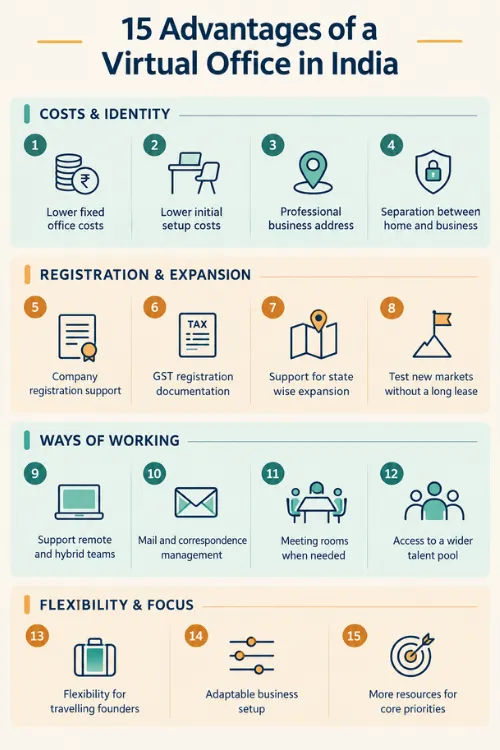
An overview of the potential benefits of using a virtual office in India, from managing office related expenses to supporting flexible business operations.
15 Key Advantages of Using a Virtual Office
1. Lower Fixed Office Costs
Maintaining a conventional office can involve monthly rent, electricity, internet, housekeeping, maintenance and other recurring expenses. These costs continue even during periods when only a few employees use the premises.
A virtual office can reduce the need for these commitments when a business primarily operates remotely or from client locations. Instead of paying for a dedicated workplace every day, the business can pay for the address and administrative services it actually needs.
The potential saving depends on the plan selected and the physical office costs avoided. Companies that still require desks, equipment or regular in person collaboration should include those expenses in their calculations.
2. Lower Initial Setup Costs
Opening a physical office may require a security deposit, furniture, computer equipment, interiors, networking infrastructure and other initial purchases. These expenses can create pressure on a startup's working capital before it has established a predictable customer base.
A virtual office arrangement may remove the need for many of these initial commitments when a dedicated workplace is unnecessary. This allows founders to begin with a simpler administrative setup instead of furnishing an office immediately.
However, these costs are avoided rather than eliminated from every business model. A company that needs employees, specialist equipment or physical facilities will still have to budget for those requirements.
3. A Professional Business Address
A commercial address can help a business maintain consistent contact details across its website, business correspondence and other permitted customer facing communications. It can also give a newly established company an identifiable business address separate from the founder's personal location.
A suitable virtual office address may be useful for consultants, independent professionals and businesses that do not receive customers at their working premises.
The address should be selected for its practical suitability rather than appearance alone. Businesses should check the provider's location, the services included and whether the address can be used for the intended purpose. A commercial address by itself does not guarantee customer trust or business credibility.
4. Greater Separation Between Home and Business
For entrepreneurs working from home, personal and professional correspondence can easily become mixed. Using a separate business correspondence address can help maintain clearer boundaries between family life and business operations.
Where permitted, a virtual office address can be used in suitable customer facing materials instead of displaying a home address. Mail handling services may also help founders manage business correspondence without receiving everything at their residence.
This is a practical privacy benefit rather than complete anonymity. Identity verification, company records and statutory filings may still require personal residential details or public disclosure of certain business information. The exact requirements depend on the business structure and the documents involved.
5. Support for Company Registration
A new company needs to establish a registered office that meets the applicable legal requirements. Under Section 12 of the Companies Act, 2013, a company must maintain a registered office capable of receiving and acknowledging communications and notices. The Act also sets out requirements for verifying the registered office with the Registrar of Companies.
A suitable virtual office arrangement may help a founder meet this administrative need without immediately leasing a dedicated workplace. The address, supporting documents and actual arrangement must satisfy the requirements applicable to the company.
A provider's documentation does not guarantee incorporation or registration approval. Before selecting a plan, founders should confirm that it permits use as a registered office and review the requirements with a company secretary or other qualified professional.
6. Support for GST Registration
Businesses that need GST registration must provide appropriate details and evidence for their principal place of business. Depending on the circumstances, documentation relating to an additional place of business may also be required.
A virtual office for gst registration may help when the premises arrangement is genuine, the selected plan permits the intended use and the required supporting documents satisfy the applicable rules.
The GST Portal's registration guidance explains the documentation process for the principal place of business. Its principal place of business guidance also explains how shared premises should be identified in the application.
In addition, the CBIC Instruction No. 03/2025 GST, issued on 17 April 2025, addresses the documents to be considered for rented, owned, consent based and shared premises. Applications may be examined or physically verified where applicable.
Businesses should therefore verify the documents and permitted use of their selected premises before applying. A virtual office provider cannot guarantee the grant of GST registration.
7. Support for Expansion Across States
A business may eventually need to establish a presence in another Indian state. This can arise when its operations expand, its commercial activities change or its registration obligations require a place of business in another state.
A suitable address arrangement can help with administrative planning when the company is assessing its options. Where a separate GST registration is required, the business must meet the requirements applicable to that registration, including providing appropriate premises information and supporting documents.
The important distinction is that obtaining another address does not automatically create a GST registration obligation or satisfy every requirement for registration. The need for registration depends on the business's circumstances and applicable tax rules.
Businesses should also ensure that the declared premises accurately reflect their arrangements. For example, a company storing inventory in a warehouse must address the registration and documentation requirements relating to the actual storage location rather than assuming that a correspondence address covers those activities.
8. Entry Into New Markets Without an Immediate Long Term Lease
Expanding into a new city can involve uncertainty. A business may need time to understand local demand, identify customers, develop partnerships and determine whether a permanent team is necessary.
A virtual office can provide an administrative starting point where an address is useful but daily office occupancy is not yet justified. The company can assess the market and arrange physical meetings when required instead of committing to a conventional office lease at the outset.
For example, a consulting firm exploring a new city may use its existing remote team to approach prospective clients and arrange meetings only when opportunities arise.
This arrangement is most useful when the company can genuinely serve customers remotely or through occasional visits. Businesses that require a staffed local branch, walk in customer service or physical operations will need to evaluate additional premises.
9. Support for Remote and Hybrid Teams
Remote and hybrid teams do not always need to work from one central office. Employees may work from home, client locations or shared workplaces while the company continues to require a stable administrative contact point.
A virtual office can provide that point of reference without requiring the entire team to attend the same premises daily. It can be particularly relevant to software companies, digital agencies, consultants and service businesses whose work can be carried out across locations.
However, an address does not automatically improve employee productivity. Companies still need clear communication practices, appropriate technology, defined responsibilities and opportunities for collaboration. The value of the arrangement depends on how well it supports the team's actual working model.
10. Mail and Business Correspondence Management
Official letters, contracts, notices and other correspondence may continue to arrive even when a company's employees work remotely. Without a consistent arrangement for receiving these items, important communication can be overlooked or delayed.
Depending on the plan, a virtual office provider may receive mail and packages on behalf of the business. Some providers may also offer notification, collection or forwarding services.
Before choosing a service, businesses should confirm what types of mail are accepted, how quickly notifications are sent, how forwarding charges are calculated and who is authorised to collect documents.
This is especially relevant when the business receives time sensitive correspondence. Mail handling can support administration, but the company remains responsible for monitoring its communications and responding within applicable deadlines.
11. Meeting Facilities When Required
Some businesses need a physical meeting space occasionally rather than every day. Client presentations, interviews, planning discussions and confidential conversations may require a suitable room even when the team normally works remotely.
A virtual office arrangement may be paired with access to meeting rooms that can be booked when needed. This can help a business arrange an appropriate space for a particular appointment instead of maintaining an unused meeting room throughout the month.
Access is not universal across all plans. Meeting rooms may require separate reservations, additional charges or advance booking. Availability and the facilities included should be confirmed before an important meeting is scheduled.
For companies with frequent in person discussions or regular team attendance, comparing occasional bookings against a dedicated office remains important.
12. Access to a Wider Talent Pool
Businesses that do not require all employees to work from one office may be able to consider candidates from a broader geographic area. This can be useful when specialist skills are difficult to find locally or when the best candidate is not based near the company's administrative address.
A virtual office may support this setup by keeping the business's correspondence arrangements separate from where individual employees work. The operational advantage, however, comes primarily from the company's remote working model rather than from the address itself.
Employers must still consider applicable employment obligations, payroll arrangements, data security, working hours and team coordination. A wider recruitment area is useful only when the business can manage a distributed workforce effectively.
13. Greater Geographic Flexibility for Founders
Consultants, entrepreneurs and business owners may spend considerable time travelling between clients, suppliers and business locations. Maintaining an office that requires their frequent physical presence may not always be practical.
A virtual office can provide a stable business contact point while the founder works from different locations. Depending on the services included, correspondence can be received at the designated address even when the owner is away.
This can be useful for independent consultants, business development professionals and founders whose work involves regular travel.
Geographic flexibility does not remove the need to respond to official communications, maintain accurate business records or attend physical meetings when required. Businesses should ensure that someone is responsible for handling important correspondence in the founder's absence.
14. A More Adaptable Business Setup
Business needs can change considerably during the first few years of operation. A small consultancy may remain fully remote while a growing technology company may eventually need dedicated desks, larger meeting rooms or a managed office.
Separating the business address from daily workspace requirements can make it easier to assess these decisions independently. A company may continue using an address service while arranging additional workspace only when the need arises.
The flexibility depends on the contract, available locations and permitted services. Businesses should review renewal terms, cancellation provisions and charges for changing the arrangement.
They should also account for any updates required to official records if their registered office or place of business changes. A flexible setup is most useful when the administrative consequences of changing addresses are considered in advance.
15. More Attention and Capital for Core Business Priorities
An office is a means of supporting business activities rather than an objective in itself. When a company does not need a dedicated workplace, committing money to rent, furniture and unused facilities may not be its most important priority.
A virtual office can give such businesses another way to organise their address and administrative needs. Depending on the costs avoided, this may leave more resources available for product development, employee training, technology, customer acquisition or service improvements.
The benefit should be assessed through an actual cost comparison rather than an assumed percentage of savings. Businesses should include the service subscription, administrative charges, meeting room bookings and any additional physical workspace they still require.
The right decision is the one that allows the business to meet its operational and legal requirements without committing resources to facilities it does not currently need.
Who Benefits Most From a Virtual Office?
A virtual office is most useful when a business needs a stable address and selected administrative services but does not require a conventional office for daily work. Its suitability depends on the activities of the business and the services included in the selected plan.
Startups and early stage businesses may find it useful when they need to establish business contact details and assess registration requirements before investing in a dedicated workplace.
Consultants and freelancers may benefit from keeping business correspondence separate from personal life while continuing to work from home or visit clients.
Remote and distributed teams can maintain a consistent administrative contact point even when employees work across different locations.
Small and medium sized businesses exploring new cities may use an appropriate address arrangement while assessing commercial demand and planning their next stage of growth.
Service businesses with occasional client meetings may find the arrangement practical when they need meeting facilities only for specific appointments.
Online businesses may use an address service for suitable administrative requirements, but they must separately assess their tax registrations, storage arrangements, fulfilment operations and other physical requirements.
A virtual office is not automatically the right choice for all these groups. The arrangement must match the company's actual activities and the relevant registration requirements.
When a Virtual Office May Not Be Enough
A virtual office is not a substitute for every kind of physical workplace. Businesses should assess their operating requirements before deciding that an address based arrangement will meet their needs.
A company may require a conventional or managed office if employees need dedicated workstations, equipment or daily face to face collaboration. Businesses that manufacture products, hold inventory or operate warehouses also need appropriate physical premises for those activities.
Similarly, customer facing operations may need an accessible location where customers can visit and receive services. A provider's address service should not be assumed to include these facilities unless they are expressly available and suitable.
Regulatory requirements are another important consideration. If an intended registration or business activity requires documents, premises or facilities that a particular arrangement does not provide, the business must make alternative arrangements.
The practical question is not whether a virtual office is cheaper than a conventional office in general. It is whether the services it provides are sufficient for the company's actual needs.
A Business Scenario: Starting Small Before Expanding
Consider a growing consulting business with a founder and a small team working remotely. The business needs a professional contact address, has some administrative documentation requirements and occasionally meets clients in person.
Instead of immediately leasing a dedicated office, the founder evaluates an address service that permits the intended use and provides the necessary documentation. The team continues working remotely and books meeting facilities for important client discussions.
As the business gains more customers, the founder reviews the arrangement against the team's actual working patterns. If employee attendance increases or the business needs dedicated facilities, a coworking space or managed office may become more suitable.
The lesson is straightforward: the business can assess its infrastructure needs in stages rather than assuming that a conventional office must be its first investment.
This is an illustrative scenario, not a real company case study. Its suitability depends on the company's activities, applicable regulations and the services offered under the selected agreement.
Practical Takeaways Before Choosing a Virtual Office
Before selecting an arrangement, businesses should work through the following considerations.
-
Identify the purpose. Decide whether the requirement is for correspondence, company registration, GST documentation, an additional business location or occasional meeting space.
-
Verify the intended use. Check that the provider permits the proposed use of the address and that the actual premises arrangement supports it.
-
Review the documents. Confirm the agreement, ownership or consent evidence and other documents required for the relevant registration.
-
Seek appropriate professional advice. Discuss company registration and GST requirements with a qualified company secretary, accountant or tax professional where necessary.
-
Compare the total cost. Include the subscription, deposits if applicable, meeting room bookings, forwarding charges and any separate workspace that remains necessary.
-
Confirm mail handling. Understand notification procedures, forwarding arrangements, collection rules and responsibility for urgent correspondence.
-
Check physical facilities. Verify meeting room availability, booking conditions and any additional charges before relying on them.
-
Read the contract carefully. Review the duration, renewal process, cancellation terms and charges for changes or additional documentation.
-
Plan for growth. Consider whether the arrangement will remain suitable if the team expands, operations move to another location or the company eventually requires a physical office.
A virtual office should be assessed as part of the business's wider operating plan rather than selected on price or address alone.
Final Thoughts
A virtual office is not simply a cheaper substitute for a traditional office. It is an option for separating a business's address and administrative needs from the location where its people actually work.
For some startups, consultants and distributed businesses, this separation can make it easier to manage costs and organise business correspondence without committing to a full office from the beginning. For others, regular collaboration, customer access or operational requirements may make a physical workplace necessary.
The most sensible approach is to assess what the business needs today, verify the relevant documentation and permitted use, and plan for the infrastructure it may need tomorrow. The goal is not to avoid having an office at all costs. It is to choose a setup that supports how the business actually operates.
Frequently Asked Questions
What is a virtual office and how does it work in India? +
A virtual office provides a business address and may include services such as mail handling, registration documentation and meeting room access. The business can use these services while employees work from home, client locations or other workplaces. The exact facilities and permitted uses depend on the provider and the agreement. A virtual office does not automatically provide a dedicated workspace or satisfy every legal requirement.
What are the main advantages of a virtual office for a small business? +
The main advantages can include lower fixed office costs, reduced initial setup expenses, a professional business address, separation of business and personal correspondence, administrative support and flexibility for remote working. The value depends on whether the business genuinely needs a conventional office. A company with daily space requirements may find another workspace arrangement more appropriate.
Is a virtual office legal in India? +
A properly documented virtual office arrangement can support certain business registration and correspondence needs in India when it meets the applicable requirements. The legal position depends on the purpose, the actual premises arrangement, the documents provided and the requirements governing the proposed use. Not every plan is suitable for every registration or business activity. Businesses should review the relevant rules and seek professional advice rather than assume that every virtual office arrangement is interchangeable.
Can a virtual office address be used for GST registration? +
A virtual office for gst registration may be suitable when the arrangement meets applicable GST requirements and the applicant has the required documents for the declared place of business. The GST Portal's registration guidance sets out the process for providing principal place of business details. The CBIC's 2025 registration instruction explains acceptable documentation routes for different types of premises. Approval is not guaranteed. Applicants should verify the permitted use of the address, the supporting evidence and the requirements that apply to their particular registration.
Can a company use a virtual office as its registered office? +
A company may be able to use a suitable virtual office arrangement as its registered office if the address and supporting arrangements meet the applicable company law requirements. Section 12 of the Companies Act, 2013 requires a company's registered office to be capable of receiving and acknowledging communications and notices. It also provides for verification of the registered office. The company should confirm that its agreement permits this use and that it can meet the relevant filing and documentation obligations. Approval should not be assumed merely because a provider offers a registered office plan.
Is a virtual office suitable for a business with remote employees? +
It can be suitable for a business whose employees already work remotely and whose main requirement is a stable address for business correspondence and selected administrative services. However, the company must still provide the technology, communication processes and management support its employees need. It may also need meeting facilities or dedicated workspaces as the team grows. The address supports the operating model but does not replace these other requirements.
When should a business choose a physical office instead of a virtual office? +
A physical office may be more suitable when employees need daily desks, teams collaborate in person frequently, customers visit the premises or the business requires specialist equipment and facilities. Manufacturing, storage and other activities that depend on physical premises also require appropriate locations. Businesses should compare the costs and facilities of the available options against their actual work and regulatory needs.