


Every startup in Karnataka defaults to Bengaluru. The talent is there, the ecosystem is there, and the investors are there. But so is the rent, the attrition, and the operational pressure that quietly eats through runway faster than most founders expect.
Hubbli is not a consolation prize for startups that cannot afford Bengaluru. For the right kind of business, it is the smarter call. Here is an honest breakdown of what each city actually costs and which one makes sense to you.
Bengaluru: The Default Choice
Bengaluru earns its reputation. If you are building a product company, a SaaS business, or anything that needs deep engineering talent and ecosystem access, Bengaluru is genuinely hard to replace. The talent pool is deep, the investor network is active, and the concentration of tech companies creates a hiring market that, while competitive, gives you options.
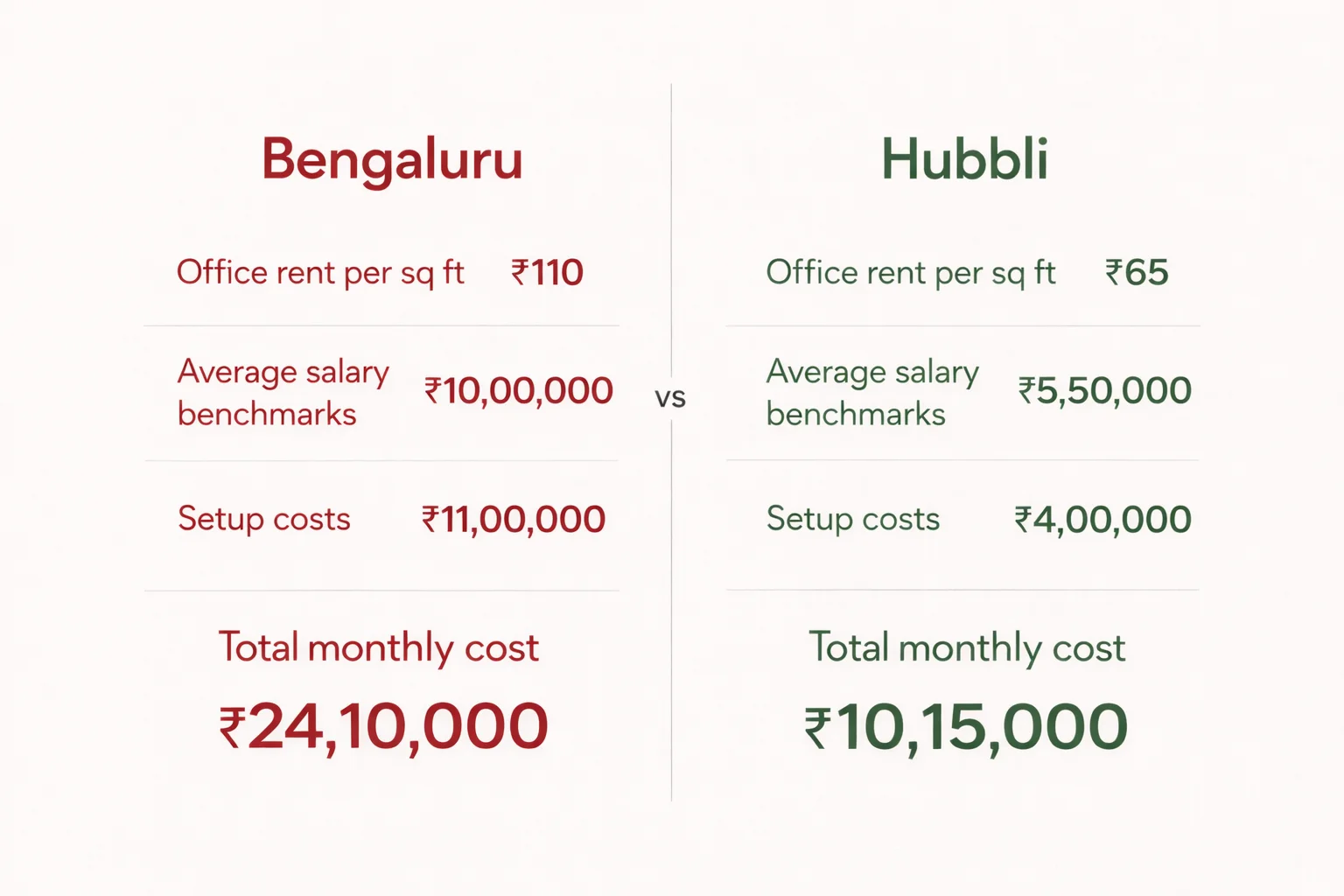
Coworking space in Bengaluru runs between Rs 8,000 and Rs 15,000 per seat per month in areas like Koramangala, HSR Layout, and Whitefield. Managed office setups in the same corridors push between Rs 12,000 and Rs 20,000 per seat. Support staff salaries are higher than in most other Karnataka cities. Setup timelines run two to four weeks minimum for anything beyond a basic coworking desk.
The attrition problem is real and persistent. Bengaluru's talent market moves fast. Engineers and operations professionals cycle through companies at a pace that drives up hiring costs and makes institutional knowledge fragile. For a startup in its early stages, losing two or three key people in the same quarter is not just an HR problem. It is an existential one.
Bengaluru is the right choice if ecosystem access, investor proximity, and deep tech hiring are non-negotiable. If they are not, the premium deserves scrutiny.

Hubbli: The Smarter Bet for the Right Business
Hubbli does not have Bengaluru's ecosystem. It does not pretend to. What it has is a growing commercial base, a strong engineering college network including KLE Tech and KLS Gogte Institute of Technology, and office costs that are 60 to 70 percent lower than Bengaluru's on a per-seat basis.
Coworking space in Hubbli runs between Rs 3,000 and Rs 6,000 per seat per month. Managed office setups come in at Rs 5,000 to Rs 9,000 per seat. Support staff salaries run 30 to 40 percent lower than Bengaluru equivalents. Setup timelines compress to one to two weeks. And the talent that joins tends to stay longer, because the competitive poaching pressure that defines Bengaluru's market simply does not exist at the same intensity in Hubbli.
For ops-heavy teams, FMCG distribution functions, manufacturing support operations, and back-office functions that do not require Bengaluru's specific talent density, Hubbli offers a genuinely strong value proposition. The infrastructure is there. The workforce is there. The cost structure is dramatically better.

Side-by-Side Cost Breakdown
| Cost Factor | Bengaluru | Hubbli |
|---|---|---|
| Coworking per seat/month | Rs 8,000 to Rs 15,000 | Rs 3,000 to Rs 6,000 |
| Managed office per seat/month | Rs 12,000 to Rs 20,000 | Rs 5,000 to Rs 9,000 |
| Support staff avg. salary | Higher | 30 to 40% lower |
| Setup time | 2 to 4 weeks | 1 to 2 weeks |
| Attrition risk | Higher | Lower |
| Talent depth | Deep across sectors | Strong in ops and engineering |
These are indicative ranges. The gap is consistent enough to materially affect a startup cost structure over a two-to-three-year horizon.
What You Give Up and What You Gain
Choosing Hubbli over Bengaluru means giving up ecosystem density. If your fundraising depends on being in the same city as your investors, if your product roadmap requires hiring niche engineering profiles, or if your sales model depends on being embedded in Bengaluru's startup community, Hubbli will feel like a constraint.
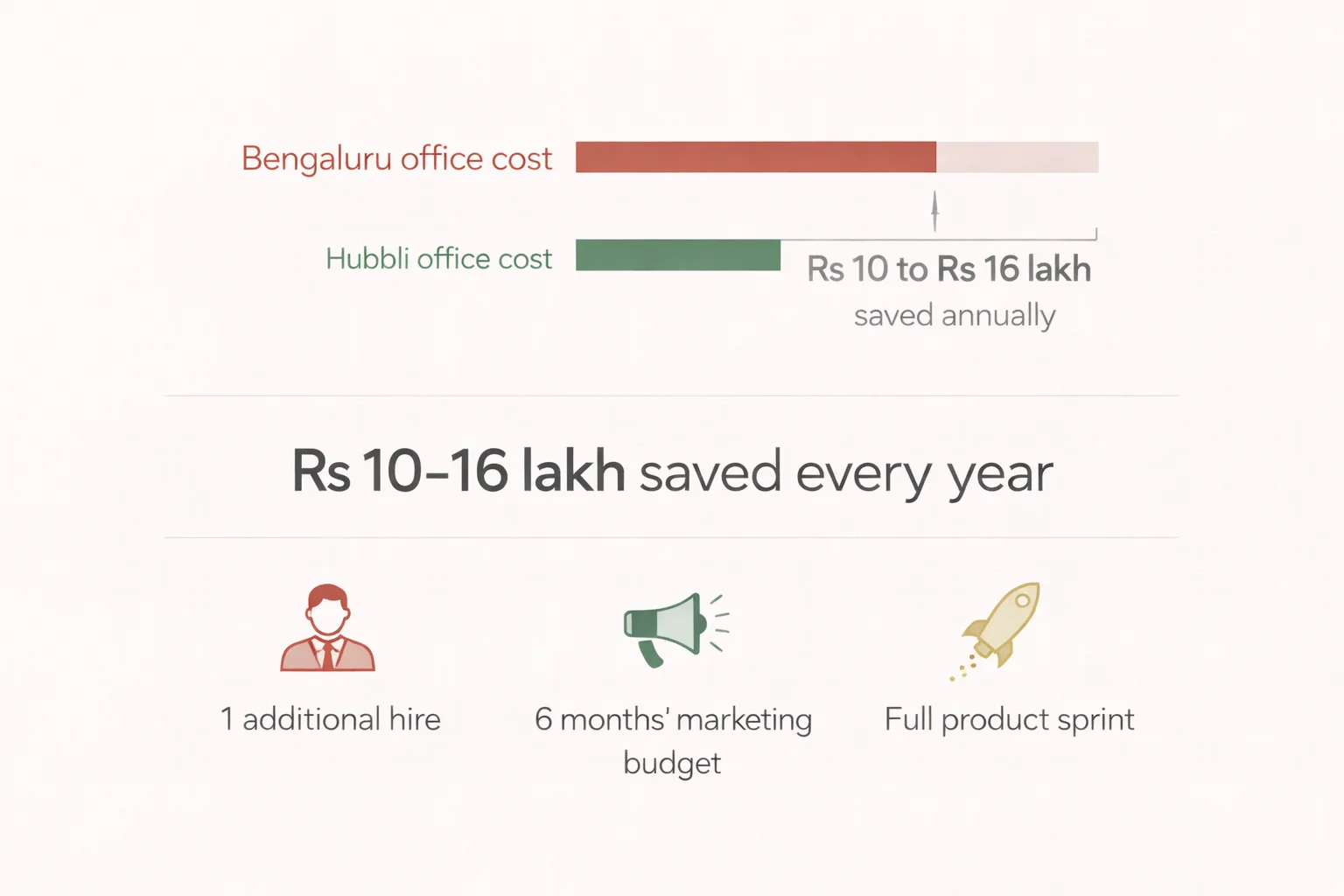
What you gain is the runway. A 15-person team paying Bengaluru rates for managed office space spends between Rs 18 and Rs 30 lakh per year on workspace alone. The same team in Hubbli spends between Rs 7.5 and Rs 13.5 lakhs. That gap, Rs 10 to Rs 16 lakhs annually, is hiring budget, product investment, or simply the buffer that keeps a startup alive through a slow quarter.
For businesses where the work does not require Bengaluru, paying Bengaluru prices is a choice, not a necessity.
Who Should Choose Hubbli Over Bengaluru
Choose Hubbli if you are building an operations team, a regional sales function, a distribution or logistics base, or a back-office support center. Choose it if you are a manufacturing-adjacent business that needs proximity to North Karnataka's industrial corridor. Choose it if retention stability matters more than talent depth and if your growth model is measured rather than hypergrowth.
Stay in Bengaluru if you are VC-backed and need the ecosystem, if your product requires specialist engineering hiring, or if your clients and investors expect a Bengaluru address.
The honest answer for many startups is both. Bengaluru for the functions that need it. Hubbli for the ones that do not.
Why Managed Office Makes Sense in Both Cities
Whether you choose Bengaluru or Hubbli, the same principle applies. Test the market before you commit. A coworking space gives you a professional, compliance-ready setup from day one without locking capital into a deposit or a multi-year lease. In Bengaluru, that flexibility protects you from overcommitting to a premium cost base before the business justifies it. In Hubbli, it lets you establish a proper presence in a new market without betting on a headcount plan that may change in six months.
Same format. Different price points. Same logic.
The question is not which city is better. It is which city your specific team, at your specific stage, actually needs. Answer that honestly, and the cost comparison makes the decision for you.