
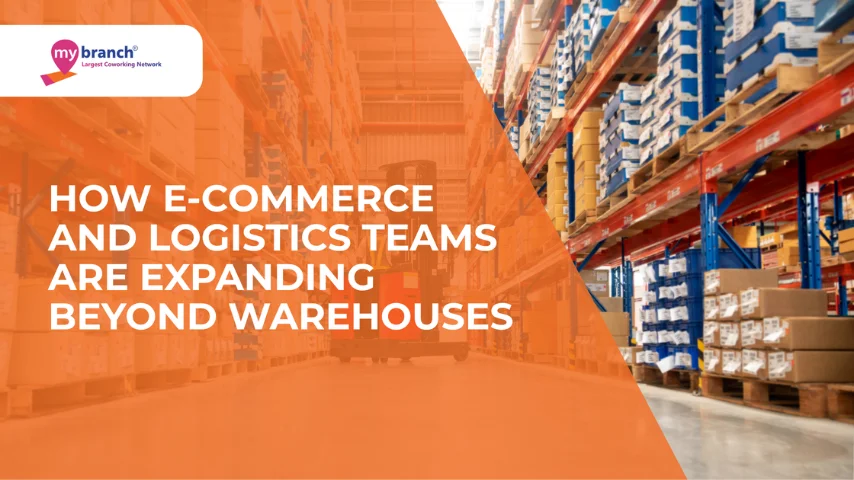
The warehouse is no longer enough. E-commerce and logistics firms have spent the last five years building warehousing infrastructure across India's Tier 2 cities. What they are discovering now is that the warehouse without a proper operational office is only half the setup.
India's logistics and warehousing sector continues to expand, with approximately 37.5 million square feet of warehousing space leased in just the first nine months of 2024 alone. Tier 2 and Tier 3 cities now contribute around 35 percent to India's e-commerce market, expected to reach 50 percent by 2026. The demand is there. The warehousing is being built. What is lagging behind is the office infrastructure that supports everything the warehouse cannot handle: route planning, vendor coordination, 3PL partner management, D2C returns processing, last-mile escalations, and compliance documentation.
India's D2C market, currently valued between 10 and 12 billion dollars, is projected to expand to 60 billion dollars by 2030, and the brands driving that growth are finding that managing Tier 2 expansion from a head office in Mumbai or Bengaluru creates exactly the operational problems that erode margins fastest. RTO rates dropped from nearly 39 percent during the November 2025 festive season to about 21 percent by February 2026. A sign that better on-the-ground operational management is already making a measurable difference.
The solution most e-commerce and logistics firms are landing on is a lean, professional regional office at the cities where operational coordination actually needs to happen.
The Six Cities Where Coordination Actually Happens
Hyderabad is rapidly gaining prominence as a major logistics hub in South India, with strong infrastructure and a growing role in e-commerce fulfilment. For e-commerce firms managing South India operations and 3PL firms coordinating multi-city distribution, coworking space in Hyderabad gives operations and supply chain teams a professional base in one of India's most active logistics markets.
Rajahmundry anchors the Godavari corridor in coastal Andhra Pradesh, with significant FMCG and D2C distribution activity across the region. For logistics coordinators managing last-mile delivery networks across eastern AP, coworking space in Rajahmundry provides an immediately operational base without the cost of a standalone office in a market where conventional lease quality remains inconsistent.
Salem is Tamil Nadu's industrial anchor in the northern interior, strategically positioned between Chennai, Bengaluru, and Coimbatore. For D2C brands and 3PL operators managing distribution across Tamil Nadu, coworking space in Salem at Fairlands puts a route planning and vendor coordination team at the geographic center of one of South India's busiest distribution corridors.
Hubballi is North Karnataka's commercial hub and an increasingly important node for FMCG and D2C distribution across the state. Coworking space in Hubballi at Gokul Road gives logistics operations teams a professional, compliance-ready base for managing distributor relationships and last-mile coordination across the Karnataka interior.
Kolhapur sits at the intersection of Maharashtra and Karnataka commerce, well-connected to Pune, Mumbai, and Goa, and increasingly relevant for D2C brands managing western Maharashtra distribution. Coworking space in Kolhapur at Rajarampuri gives e-commerce and 3PL teams a credible operational base in a city that most competitors have not yet reached with proper office infrastructure.
Ambala anchors the North India distribution corridor on NH44, making it a natural base for e-commerce firms managing supply chains across Haryana, Punjab, and Himachal Pradesh. Coworking space in Ambala at Sadar Bazar puts a route planning or 3PL coordination team at one of North India's most strategically positioned commercial junctions.
Why Managed Offices Fit This Expansion Model
E-commerce and logistics headcount is tied to order volumes, festive seasons, and distribution contracts rather than fixed annual plans. A conventional lease that locks in a fixed team size for three to five years is structurally misaligned with how these businesses actually operate.
MyBranch, India's largest coworking network with presence across 75 plus cities, gives e-commerce and logistics firms a managed office space at each coordination node, with seat counts that flex with order volumes, compliance-ready addresses for GST and regulatory filings, and immediate setup timelines that mean operations teams can be functional before the next fulfilment cycle begins.
The brands and logistics firms that get their regional office infrastructure right in 2026 are the ones that will manage the D2C boom without watching their margins disappear into last-mile inefficiency and remote management overhead.
Related Blog:- Managed Office vs Traditional Lease India: 2026 Comparison
Frequently Asked Questions
Why do e-commerce and logistics companies need regional offices beyond their warehouses? +
Warehouses handle physical fulfilment but cannot manage the operational coordination that surrounds it, including route planning, vendor management, 3PL partner oversight, returns processing, last-mile escalations, and compliance documentation. A regional office at key distribution nodes significantly improves operational efficiency and reduces costs like RTO rates.
Which cities are most important for e-commerce and logistics regional offices in India in 2026? +
Hyderabad, Rajahmundry, Salem, Hubballi, Kolhapur, and Ambala are among the strongest operational nodes for e-commerce and logistics regional offices in 2026, covering South India, western Maharashtra, North Karnataka, and the North India distribution corridor.
What is the best office format for e-commerce and logistics regional teams? +
Managed coworking offices are the strongest fit because e-commerce and logistics headcount fluctuates with order volumes and festive seasons. Flexible seat counts, immediate setup, and compliance-ready addresses make managed offices far more practical than conventional leases for teams whose size changes significantly across the year.
How much of India's e-commerce market comes from Tier 2 and Tier 3 cities? +
Tier 2 and Tier 3 cities currently contribute around 35 percent to India's e-commerce market, expected to reach 50 percent by 2026 according to IBEF data. This shift is driving significant logistics and operational investment into smaller cities beyond the established metro hubs.
Does MyBranch have managed offices in cities relevant for e-commerce and logistics expansion? +
Yes. MyBranch, India's largest coworking network, operates across 75 plus cities including Hyderabad, Rajahmundry, Salem, Hubballi, Kolhapur, and Ambala, giving e-commerce and logistics firms consistent, immediately operational managed office infrastructure across their key distribution nodes.