
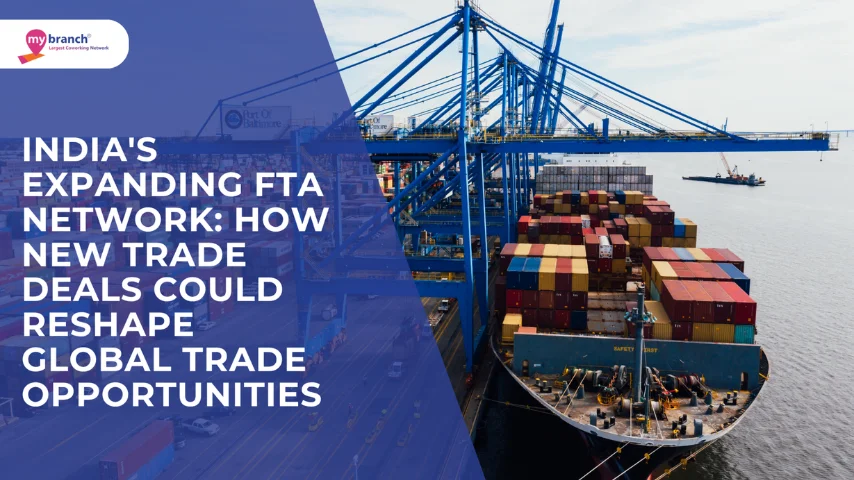
Indian companies are dealing with more countries and currencies than ever. Commerce Minister Piyush Goyal recently said India is negotiating with eight to nine more country groups, widening the reach of its trade agreements.
The real question for a founder is simpler. Could this open more doors abroad?
India's Trade Network Is Expanding
India has signed nine free trade agreements in the last four years, covering economies worth 60 trillion dollars and 38 developed countries. With earlier pacts covering Japan, Korea and ASEAN, India now has preferential access into roughly 70 trillion dollars of economic activity.
Talks are underway with more blocs worth another 15 trillion dollars in GDP. Officials expect these to eventually cover close to 75 percent of global trade, a direction being worked toward, not a level already reached.
Did You Know?
India has signed bilateral trade deals in the form of FTAs, CEPAs, CECAs and PTAs with some 18 groups and countries, according to the Indian Trade Portal run by the Department of Commerce.
How New FTAs Could Create Opportunities
An agreement can lower tariffs on specific products and simplify entry rules. The India-UK trade agreement, in force since July 2026, removed duties on 99 percent of Indian exports to the UK by value.
The benefit is never automatic. It depends on the product and the exact terms negotiated.
Why SMEs Could Benefit
Smaller exporters often lack the scale to absorb tariffs, so a reduction can matter more to them. But rules of origin, certification and working capital can still slow down a strong product.
FTAs Are Not a Guarantee of Success
An agreement changes the trade environment, not customer demand or product quality. Businesses still compete on price and brand trust. Currency movement and freight costs can erase a tariff advantage as easily as amplify it.
Goods and Services: A Broader Opportunity
India's services exports touched a record 421 billion dollars in FY26, led by IT and business services. Agreements increasingly cover professional mobility too, which matters for consulting firms as much as manufacturers.
Supply Chains and Diversification
Businesses increasingly weigh trade agreements when deciding where to source or distribute. A wider FTA network could encourage more diversified sourcing, though this also depends on factors beyond trade policy.
Consider a growing Indian manufacturer eyeing a European market that looks more attractive once tariffs ease. It still needs to study demand, confirm certification and map local competition.
What Founders Should Consider
Before treating an FTA as an opportunity, ask what tariff benefit applies to your product, whether you meet the rules of origin, and whether your supply chain can support the demand you are chasing.
Practical Takeaways
Study the target market before assuming demand exists. Check the product-specific tariff benefit. Understand rules of origin and certification needs. Calculate full landed cost, not just tariff savings. Diversify across markets rather than one country.
As plans take shape, many businesses rethink footprint too, from managed office space for a regional team to office space solutions for short term entry.
Closing Reflection
India's expanding trade network could open more routes into international markets over time. Whether a business benefits still depends on its product, pricing and readiness to execute abroad.
Frequently Asked Questions
What is a Free Trade Agreement? +
A Free Trade Agreement is a treaty between two or more countries that reduces or removes tariffs and other trade barriers on covered goods and services. It sets out which products qualify for preferential treatment and under what conditions.
How can FTAs benefit Indian businesses? +
An FTA can lower the tariffs an Indian exporter pays in a partner market, which improves price competitiveness against local or third-country suppliers. It can also simplify some customs and documentation requirements and open access to sectors or procurement markets that were previously restricted.
Do FTAs help Indian SMEs and exporters? +
They can, but the benefit is not automatic. SMEs that understand the specific tariff lines relevant to their product and that can meet documentation and certification requirements are better placed to use an FTA. Those that are not prepared for compliance and logistics may struggle to convert the opportunity into actual exports.
Does an FTA mean all products enter tariff-free? +
No. Tariff benefits under an FTA are product-specific and are set out line by line in the agreement. A product also has to meet the agreement's rules of origin, which define how much of it must be made or processed within the member countries, before it qualifies for preferential treatment.
What should a business check before entering a new FTA market? +
A business should verify actual demand for its product in that market, confirm the tariff benefit that applies to its specific product category, check certification and regulatory requirements, calculate the full landed cost, and assess whether it needs a local partner or distributor to reach customers reliably.