

India’s financial services industry needs people who can understand financial data, manage risk, support business decisions and work with increasingly digital systems. Yet many fresh graduates still find it difficult to secure their first finance role. The question is not simply whether India has enough finance jobs or enough graduates. It is whether employers can find candidates whose qualifications and practical abilities match the responsibilities of the roles they need to fill. This is the tension explored in The Hindu’s report on the challenges facing fresh finance graduates.
The distinction matters for business leaders and hiring managers. A company recruiting a financial analyst may look for spreadsheet proficiency and forecasting skills while a bank hiring for credit operations may prioritise data accuracy, regulatory awareness and customer communication. An investment research team may need a different combination of market knowledge and analytical judgement. Although all these positions fall within the finance ecosystem, their requirements are not identical.
Understanding this difference is the starting point for explaining why demand for finance professionals can coexist with difficulties for graduates entering the workforce. The challenge involves the type of roles available, what employers expect candidates to demonstrate and how effectively education and early career training prepare people for actual work.
Why Industry Demand Does Not Automatically Mean Fresher Hiring
Growth in financial services does not automatically translate into an equal increase in opportunities for every qualification or experience level. Employers recruit according to their business requirements, the functions they need to strengthen and the skills candidates must bring to each position.
Consider the range of work performed across India's financial services ecosystem.
Banking teams recruit for customer service, credit assessment, financial operations, compliance and risk management. Accounting and audit teams need people who understand financial statements, reporting standards and internal controls. Financial planning and analysis teams work with budgets, forecasts and business performance. Investment research relies on market knowledge, valuation and the ability to interpret financial information. Insurance and fintech businesses need different combinations of analytical, operational, regulatory and customer facing skills.
Global capability centres also perform finance activities such as reporting, analysis, accounting operations and risk support for international organisations. These positions may involve digital platforms, standardised processes and collaboration across teams in different locations.
As a result, a vacancy in one part of the sector does not necessarily suit every finance graduate. Employers may be looking for a particular professional qualification, previous exposure to an industry, familiarity with specific systems or the ability to perform a defined task from the beginning.
Current recruitment evidence illustrates this difference. According to The Economic Times’ report on BFSI hiring trends based on data released by Apna, 50.2% of the reported banking, financial services and insurance job postings in the first quarter of FY27 required no prior experience. However, entry level opportunities in credit card roles grew by 71.3% in FY26 while fresher friendly banking operations postings declined by 39.6%.
These figures relate to a specific job platform dataset rather than every finance employer in India. Nevertheless, they illustrate an important point: opportunities can expand in some functions while contracting in others. Candidates may find openings in credit, lending, insurance or fintech while encountering more competition for familiar roles in traditional banking operations.
Demand for experienced employees must also be separated from demand for fresh graduates. An organisation expanding a risk management team may need professionals who can independently evaluate complex cases. A graduate may have studied the underlying concepts but still need supervision before making comparable decisions.
The result is a mismatch between the talent businesses require and the capabilities that candidates can demonstrate at the point of recruitment. It does not mean that finance has stopped offering career opportunities or that graduates lack the potential to succeed.
Did You Know?
According to reporting on Aon’s Campus Study Report for 2026 to 2027, 56% of surveyed organisations plan to increase hiring of Chartered Accountant and Company Secretary graduates.
This indicates that employers continue to anticipate a need for specialised finance, accounting and governance talent. However, the figure represents planned recruitment rather than confirmed hiring outcomes. It also covers CA and CS graduates specifically, so it should not be interpreted as a hiring forecast for every finance qualification or entry level role.
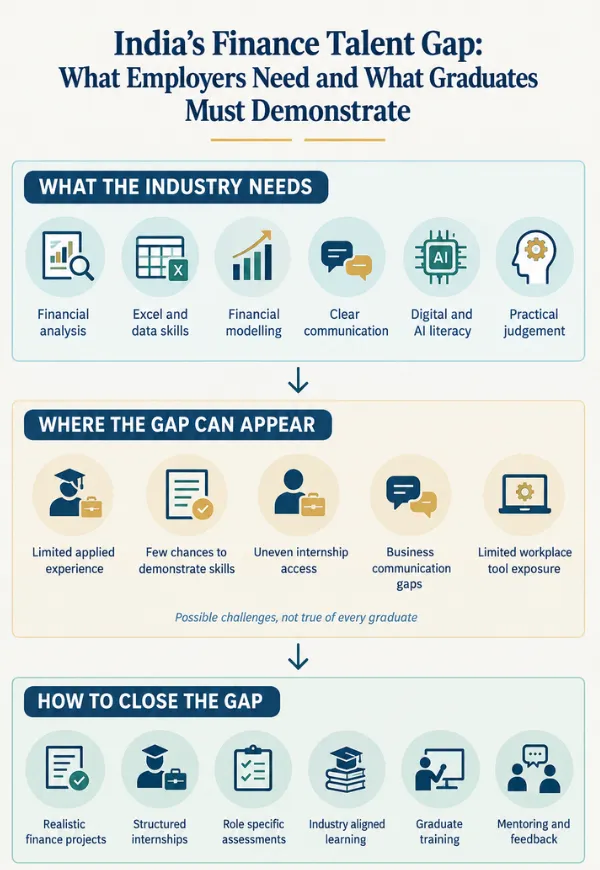
The infographic below summarises how industry expectations, possible gaps in graduate readiness and practical development measures relate to one another.
Why a Degree May Not Be Enough
A finance degree provides an important foundation. It introduces students to accounting principles, financial management, economics, taxation, business performance and related concepts. Professional qualifications can provide further depth in areas such as accounting, audit, investment analysis or corporate governance.
The challenge arises when candidates need to demonstrate how they can apply that knowledge to workplace responsibilities.
An employer may ask a new finance employee to review a set of financial statements, check the accuracy of a spreadsheet, prepare a monthly report or explain why a business unit's expenses have increased. The graduate must understand the underlying concepts, but must also be able to use data correctly, identify inconsistencies and present the findings in a form that colleagues can understand.
These capabilities are developed through a combination of education, practical assignments, workplace exposure and feedback. Classroom learning and professional examinations remain valuable, but they may not provide enough evidence of how a candidate would perform in a particular job.
Mercer’s India Graduate Skill Index 2025 reported that 42.6% of Indian graduates who apply for jobs were assessed as overall employable. The report drew on assessments involving more than one million students across over 2,700 campuses.
This is an overall graduate employability measure, not a finance graduate score. It does not prove that finance graduates have the same employability rate or that a particular qualification is insufficient. It does, however, provide broader context for the discussion about how academic achievement and workplace readiness can differ.
For employers, the practical question is therefore not whether a candidate has studied finance. It is whether the candidate can demonstrate the capabilities required for the position and how much additional training will be needed after joining.
The Skills Finance Employers Are Looking For
There is no single skills checklist that applies to every finance role. Nevertheless, research indicates that employers value a combination of technical finance knowledge, analytical ability and communication.
The CFA Institute’s research on India’s finance workforce was commissioned from Kantar and draws on insights from more than 100 firms across the finance and investment industry. It identifies financial market and product knowledge, modelling, Excel and data tools, communication and emerging technology among the capabilities valued by employers.
The report found that 68% of employers identified market and product knowledge as an important skill, 51% identified financial modelling and 49% identified communication and other soft skills. These findings reflect the employer preferences examined in that research. They should not be treated as universal requirements for every finance vacancy.
For a financial planning and analysis position, the ability to work with spreadsheets, prepare forecasts and explain changes in business performance may be particularly important. An accounting role may place greater emphasis on accurate reporting, reconciliation and compliance with internal processes. A credit analyst may need to assess repayment capacity, interpret financial information and identify potential risks.
Across these roles, some capabilities are broadly useful:
Financial analysis and reporting: Graduates should be able to read financial statements, understand key measures and explain what the numbers suggest about business performance.
Excel and data handling: Familiarity with spreadsheets, formulas, data cleaning and basic analysis helps employees work accurately with financial information. The appropriate level of proficiency depends on the role.
Modelling and forecasting: Roles involving budgets, valuation or planning may require candidates to develop assumptions, prepare scenarios and explain how changes affect an outcome.
Communication and presentation: Finance professionals often explain results to managers and colleagues who may not have a finance background. A technically accurate report has limited value if its conclusions are unclear.
Attention to detail and judgement: Checking figures, identifying unusual results and understanding when a problem needs further investigation are important responsibilities in many finance functions.
Digital and regulatory awareness: Depending on the position, employers may value familiarity with financial systems, industry regulations, reporting tools or emerging technologies.
The purpose is not for every graduate to master all these areas before applying for a job. Instead, candidates need a clear understanding of the requirements of their chosen role and credible evidence that they can meet its essential expectations.
How AI and Automation Are Changing Entry Level Finance Work
Artificial intelligence and automation are changing how some finance tasks are performed. Routine data entry, document processing, initial data classification, standard report preparation and repetitive reconciliation may increasingly involve automated systems or digital workflows.
These changes can affect the work expected from junior employees. When technology handles part of a routine process, an employee may need to spend more time checking the output, investigating exceptions and explaining what the information means.
For example, a system might prepare a preliminary report from financial data. A finance employee still needs to check whether the underlying information is accurate, whether unusual movements have been overlooked and whether the conclusions make sense in the business context.
AI output also requires judgement. A tool can produce a plausible answer that contains an error, misses relevant context or relies on incorrect information. Confidentiality and data handling rules matter as well, particularly when financial or customer information is involved.
The CFA Institute’s 2026 analysis of the skills employers want highlights the growing importance of AI, coding, data science and Python alongside financial analysis, Excel based modelling, critical thinking and communication. Its broader message is that technical and human capabilities are complementary rather than interchangeable.
The ACCA India Talent Trends 2026 report also explores technology adoption and concerns about the pace of change among finance and accountancy respondents. It provides context on changing workplace expectations, but it should not be treated as evidence that AI has eliminated a particular number of entry level jobs.
The important distinction is between automating tasks and eliminating entire jobs. A finance role may contain several activities, only some of which can be automated. Human review, exception handling, business understanding and accountability can remain necessary even when a process becomes more efficient.
For new graduates, familiarity with relevant digital tools can be useful. Equally important is knowing how to question a result, protect sensitive information and explain a conclusion. Learning to use AI responsibly should complement finance fundamentals rather than replace them.
The Internship and Practical Experience Gap
Practical experience can help employers understand what a graduate is capable of doing before making a full time offer. An internship may expose a student to reporting cycles, spreadsheets, internal systems, team communication and the standards expected in a professional setting.
Projects and case studies can also demonstrate applied ability. A candidate who has analysed a public company's financial statements, created a basic budget or prepared a spreadsheet based on sample financial data has something specific to discuss during an interview.
This matters because qualifications alone can make it difficult to distinguish between candidates when several applicants have studied similar subjects. A practical task may reveal differences in accuracy, reasoning, organisation and communication.
Aon’s campus hiring findings, reported by Mint’s coverage of the 2026 to 2027 study, indicate that internships continue to be part of early career talent strategies. The report says around 90% of surveyed organisations hire interns across the qualifications covered and around 80% to 85% use pre placement interviews or offers as a route for converting strong performers into full time employment.
These findings illustrate how internships can contribute to recruitment pipelines. They do not mean an internship guarantees a job or that every employer uses the same process.
There is also a genuine access challenge. Not every student can secure a relevant internship, and not every institution has the same access to employer projects, industry mentors or practical training. Students who have had fewer opportunities to demonstrate their skills may be less able to show their capabilities during a conventional recruitment process.
Employers can address part of this gap by offering structured internships, realistic work samples and graduate training programmes. These approaches help businesses evaluate candidates more clearly while giving new recruits opportunities to develop skills in a supported environment.
What Employers and Educational Institutions Can Do
Closing the finance talent gap requires action from more than one group. Graduates can work on their practical readiness, but employers and educational institutions influence which opportunities are available and how well learning connects with workplace needs.
Employers can make entry level recruitment more realistic
Hiring managers should define what a candidate genuinely needs to know on the first day and what can be taught after joining. A junior role may require basic spreadsheet proficiency and an understanding of accounting principles without requiring the same level of independent judgement expected from an experienced analyst.
Job descriptions should distinguish essential requirements from desirable skills. Requiring extensive experience for a role intended for fresh graduates can also narrow the candidate pool unnecessarily.
Structured assessments are another useful approach. A short financial data exercise, a basic spreadsheet task or a case study linked to the actual job can reveal how a candidate approaches a problem. These assessments should reflect the level of responsibility expected from someone starting a career.
Employers should also explain the nature of the role clearly. Candidates need to understand the daily responsibilities, software or systems they may use, the training available and the standards by which their work will be assessed.
Educational institutions can connect learning with actual tasks
Colleges and professional training institutions can strengthen practical learning through financial case studies, spreadsheet exercises, reporting assignments and opportunities to explain findings in writing or presentations.
Industry engagement can help educators understand which tasks graduates are likely to encounter. Employers can contribute sample projects, internship opportunities and feedback on the skills they observe during recruitment.
Curricula do not need to abandon core finance concepts to become more practical. Instead, students can practise applying these concepts to realistic scenarios. Understanding financial statements becomes more useful when learners also interpret performance trends or explain the implications of a change in costs.
Institutions can also teach students how to work carefully with digital tools, verify outputs and follow appropriate data handling practices.
Small businesses can build talent while they grow
For smaller organisations, recruiting a fully experienced professional for every finance task may not be practical. A better approach can be to identify which capabilities are essential and develop a plan for training new employees in the remaining responsibilities.
Recruitment, systems and workplace decisions are part of that wider operating plan. The right office space for small business should support collaboration without diverting attention from training and process improvement. A growing team may also consider flexible office space as headcount changes or a coworking space for startups while it establishes its initial finance function.
These are operational choices rather than direct solutions to the skills gap. The more important measures are clear responsibilities, effective supervision, suitable systems and enough time for new employees to learn the work.
Businesses that set realistic expectations and support early career development can create a more sustainable route from graduate potential to workplace contribution.
A Short Business Scenario: Assessing More Than a Qualification
Consider a growing finance team that receives applications from several graduates with relevant degrees. Their academic backgrounds appear similar, making it difficult for the hiring manager to identify who is best prepared for the role.
Instead of relying only on qualifications and interview responses, the manager prepares a short assessment using sample financial data. Candidates are asked to organise the figures in a spreadsheet, identify an unusual expense movement and prepare a short explanation of what they found.
The exercise does not attempt to replicate the entire job. It gives the hiring team a practical view of each applicant's approach to accuracy, analysis and communication.
One candidate may demonstrate strong spreadsheet ability but need help explaining business implications. Another may communicate confidently but require more practice in checking figures. A third may show a balanced foundation and ask sensible questions when the information is unclear.
The manager can use these observations to make a more informed recruitment decision and plan the successful candidate's onboarding. The learning plan might cover the organisation's reporting procedures, internal systems and review standards before gradually increasing responsibility.
This is an illustrative scenario rather than a real company case study. It shows how structured assessments can help employers recognise both current capability and potential for development.
What Finance Graduates and Employers Should Focus On
The practical steps for graduates and employers are different, but they should support the same objective: making it easier to match a candidate's abilities with the requirements of a role.
For finance graduates
Start by identifying the type of finance work that interests you. Accounting, audit, financial planning and analysis, credit, compliance and investment research may require different combinations of skills.
Build practical examples related to that direction. You might analyse published financial statements, prepare a sample budget, create a spreadsheet model or explain a set of business results. Use public or sample data responsibly and avoid sharing confidential information from any previous placement.
Practise explaining your work. Being able to describe your assumptions, identify limitations and communicate a conclusion is useful evidence of understanding. Where relevant, become familiar with financial software, data tools or AI applications while learning to verify their output.
Seek internships, project opportunities and feedback where available. Certificates may help demonstrate interest or knowledge, but collecting more credentials without practising their application may not address the main gap.
For employers
Be clear about the actual requirements of an entry level position. Assess candidates against tasks that reflect the job and avoid placing unnecessary experience requirements on roles designed for new graduates.
Combine technical assessments with questions about reasoning, communication and judgement. Use recruitment findings to identify what training new employees need, then review whether that training improves performance.
Internships and graduate programmes can help build a pipeline of people who understand the organisation's processes. Mentoring, regular feedback and a gradual increase in responsibility help graduates move from supervised work towards greater independence.
Employers should also review how automation changes junior responsibilities. If software takes over a repetitive task, the training plan may need to place more emphasis on checking results, resolving exceptions and understanding the business context.
Practical Takeaways for Business Leaders
-
Hire for the actual role. Distinguish the requirements of finance operations, accounting, credit, reporting and analysis instead of treating all finance graduates as interchangeable.
-
Assess applied skills. Use realistic spreadsheet exercises, data interpretation tasks or short case studies alongside academic credentials.
-
Separate essential skills from trainable skills. Identify what candidates must already know and what can be developed through structured onboarding.
-
Build clear internship pathways. Use meaningful assignments and feedback to help students understand workplace expectations and allow employers to assess potential.
-
Strengthen digital capability. Develop relevant Excel, data analysis and AI skills while retaining checks for accuracy, confidentiality and sound judgement.
-
Make entry level requirements clear. Ensure job descriptions and assessments reflect the real responsibilities of a junior employee.
-
Support learning after recruitment. Provide mentoring, realistic performance goals and opportunities to build confidence in actual business processes.
-
Work with educational institutions. Share feedback about recurring skills needs so that course projects and practical assignments can reflect workplace tasks more closely.
Closing Reflection
India's finance talent gap is best understood as a challenge of matching qualifications, practical capability and recruitment needs. Demand for finance professionals does not mean that every employer is recruiting every type of graduate, just as a difficult first job search does not mean that an entire industry lacks opportunities.
Graduates need ways to demonstrate what they can do, educational institutions need opportunities to connect concepts with practice and employers need hiring processes that recognise both current ability and the potential to learn. The most productive response is not to place the burden on one group but to make the transition from education to work more deliberate and better supported.
For businesses, this means looking beyond credentials when evaluating candidates while remaining realistic about the responsibilities of each role. For graduates, it means developing evidence of applied skills alongside academic knowledge. Closing the gap will require consistent effort from both sides rather than a single course, certificate or recruitment initiative.
Frequently Asked Questions
Why are finance graduates struggling to find jobs in India? +
The difficulty can arise when the skills demonstrated by applicants do not fully match the requirements of particular vacancies. Employers may need practical experience, data handling, communication or knowledge of specific finance processes. Conditions also differ by function, qualification and location, so the challenge is not the same across the entire industry.
Is there a shortage of finance professionals in India? +
There is no single answer that applies to every finance role. Aon’s campus hiring findings indicate planned growth in CA and CS hiring, while BFSI job posting data reported by The Economic Times shows differences between job categories. Some employers may need specialised capabilities even when other entry level roles have fewer openings.
What skills do employers expect from fresh finance graduates? +
Requirements vary by role, but useful capabilities can include financial statement analysis, Excel, data handling, accounting and reporting knowledge, attention to detail and communication. The CFA Institute’s research on India's finance workforce highlights the value of combining technical finance knowledge with analytical and interpersonal skills.
How is AI changing entry level finance jobs? +
AI and automation can reduce manual effort in some repetitive tasks, including document processing and basic reporting. This can increase the importance of reviewing outputs, checking data, investigating exceptions and explaining conclusions. AI is not evidence by itself that all entry level finance jobs are disappearing.
Does an MBA or professional certification guarantee a finance job? +
No qualification can guarantee employment. An MBA or a relevant professional certification may help develop knowledge and meet role requirements, but recruitment decisions can also depend on practical ability, experience, communication and the availability of suitable vacancies.
How can finance graduates improve their job readiness? +
Graduates can build practical projects with public or sample financial data, practise spreadsheet analysis and learn to explain their findings clearly. They can also seek internships or industry projects where accessible. The aim is to demonstrate the ability to apply knowledge rather than relying only on additional certificates.
What can employers do to close the finance skills gap? +
Employers can define entry level requirements more clearly, assess practical ability through relevant tasks and provide structured training after recruitment. Internships, mentoring and feedback from hiring managers can also help educational institutions understand where students need more practical exposure.