Choosing an office is not simply about finding enough desks for employees. As a business grows, its workspace needs begin to change. A small team may initially need only a few workstations and access to meeting rooms. An established organisation may require private work areas, company branding, controlled access and facilities designed around its daily operations.
Today, businesses can consider different workspace arrangements instead of immediately committing to a conventional commercial lease. Two options that often come into consideration are a managed office and a coworking space. Both provide access to professional workplaces but differ in the level of privacy, customisation, operational responsibility and control they offer.
The important question is not which option is more modern or affordable. It is which arrangement gives a business the right balance of flexibility, privacy, cost and operational control as its requirements evolve.
What Is a Managed Office?
A managed office is a dedicated workplace arranged for the requirements of a particular company. Instead of independently finding premises and coordinating every aspect of office setup, a business can work with a workspace provider to prepare and operate its office.
The workspace is generally designed around the company's team structure, seating requirements and working arrangements. Depending on the agreement, businesses may also have greater flexibility to influence the interior layout, meeting areas, branding and office facilities.
For example, a company with separate sales, technology and administration departments may require different working zones. Its office could include individual workstations, private cabins, conference rooms and designated collaboration areas.
A workspace provider may take responsibility for several parts of the arrangement.
Office design and setup: The provider may help identify suitable premises and plan the workspace according to the company's requirements.
Furniture and fit out: Workstations, chairs, storage areas, meeting tables and other essential office infrastructure may be arranged as part of the offering.
Technology infrastructure: Internet connectivity, networking infrastructure and certain IT facilities may be provided according to the agreed specifications.
Housekeeping and maintenance: Regular cleaning, equipment maintenance and upkeep of workplace facilities may be handled by the operator.
Security and access: Entry management, visitor arrangements and security systems can be configured according to the workspace agreement.
Daily operations: Reception, pantry management and other workplace support services may also be included.
One important point is that every managed office arrangement is different. The provider's responsibilities, customisation rights and service inclusions depend on the contract.
Businesses may retain considerable control over their internal seating arrangements, branding and employee policies while outsourcing agreed workplace operations.
This makes the model worth evaluating for companies that want a dedicated office environment without managing every aspect of its infrastructure independently.
What Is a Coworking Space?
A coworking space is a shared professional workplace where individuals, freelancers, startups and established companies use workstations and common facilities within an operator managed centre.
Unlike a dedicated office prepared around one company's requirements, coworking generally operates through memberships or workspace plans. Members use the facilities available at the centre according to their selected package.
The available arrangements can include several formats.
Hot desks: Members use available workstations rather than having one permanently assigned desk.
Dedicated desks: Individuals receive an assigned workstation that remains reserved for their use.
Private cabins: Small teams can access enclosed office areas within the shared coworking centre.
Meeting rooms: Members may book shared meeting rooms for client discussions, presentations and internal meetings.
Common areas: Lounges, breakout spaces and pantry facilities provide areas for informal discussions and everyday interaction.
Coworking can offer a ready to use professional environment without requiring a business to establish an entire office independently.
It can be particularly useful when a company requires a limited number of workstations or when employees need access to a workplace on selected days.
However, coworking should not be understood as an open desk arrangement alone. Many centres also provide private cabins and enclosed offices. The difference is that these offices operate within a larger shared workplace where the operator manages the overall environment.
Membership benefits, access arrangements and facilities vary between providers and plans.
The distinction between these models is also becoming relevant to corporate real estate planning. CBRE's March 2026 report on India's flexible workspace industry discusses how flexible workspaces are increasingly being considered for scalability, operational support and workplace experience rather than simply as an alternative to traditional office leasing.
Did You Know?
Around one fifth of India's overall office leasing came from flexible workspace operators in H1 2026.
According to Cushman & Wakefield's October 2026 India flexible office market update, operators leased approximately 8.5 million square feet across India's top eight cities during the first half of 2026.
This indicates that flexible workspace arrangements have become a meaningful part of the country's commercial office market. It also highlights why businesses should understand the differences between shared coworking arrangements and customised managed offices when planning their workplace requirements.
Source: Cushman & Wakefield, October 2026. Reporting period: H1 2026.
Managed Office vs. Coworking Space: 7 Key Differences
The following infographic summarises the main distinctions between a dedicated managed workspace and a shared coworking environment.
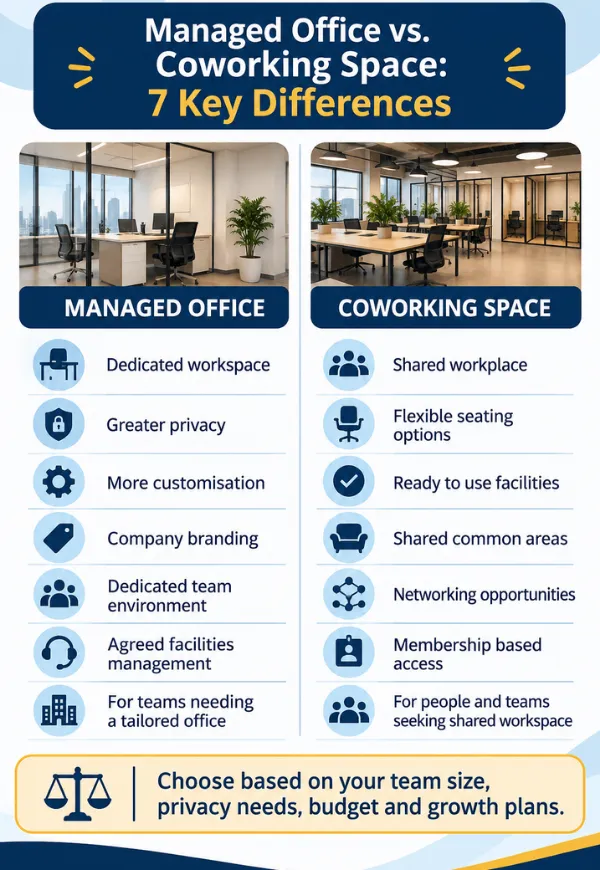
Managed Office vs. Coworking Space: Key Differences
Although both workspace models provide professional facilities and operational convenience, they are designed around different business requirements.
The following comparison explains how they differ across important workplace considerations.
|
Comparison factor |
Managed office |
Coworking space |
|
Workspace arrangement |
Dedicated workspace for a company |
Shared professional workplace |
|
Privacy |
Greater control over private working areas |
Depends on membership and private office options |
|
Customisation |
More scope for company specific layouts |
Usually follows the centre's existing design |
|
Branding |
More opportunities for company branding |
Branding opportunities may be limited |
|
Cost structure |
Depends on office size, specifications and agreement |
Usually priced by desk, cabin or membership |
|
Contract structure |
Based on agreed workspace and operating terms |
Membership plans may offer shorter commitments |
|
Facilities |
Services can be arranged for the company's requirements |
Common facilities managed for multiple members |
|
Security |
Can be configured around company requirements |
Shared centre security arrangements apply |
|
Collaboration |
Primarily focused on internal teams |
Opportunities to interact with other businesses |
|
Scalability |
Expansion requires planning and configuration |
Additional desks may be available through memberships |
|
Operational control |
Greater control over the dedicated environment |
Shared centre policies apply |
|
Best suited for |
Businesses seeking a customised dedicated workplace |
Individuals and teams seeking shared facilities |
These differences provide a general comparison rather than fixed industry rules. A coworking operator may offer private offices with considerable privacy while a managed office agreement may restrict certain design changes or operating decisions.
The actual arrangement matters more than the product name.
1. Privacy, Branding and Workspace Control
Privacy is one of the most important considerations when selecting a workplace.
Businesses regularly handle information that should not be casually accessible to visitors or employees from other organisations. Financial discussions, client meetings, recruitment interviews and internal planning conversations may require a controlled environment.
A managed office can provide greater control over the areas used by the company's employees. The business may have dedicated workstations, enclosed meeting rooms and designated spaces for confidential discussions.
This arrangement can be useful for organisations that regularly handle sensitive business information or require restricted access to specific departments.
However, coworking does not automatically mean working in an open environment.
Many coworking centres provide private cabins and enclosed meeting rooms. Businesses can use these facilities to maintain separation from other members while continuing to benefit from shared infrastructure.
The important difference is the level of control.
In a coworking environment, the operator generally manages the common areas, reception and overall centre access. In a managed office, the company may have more influence over internal access arrangements and workplace policies within its dedicated area.
What About Company Branding?
Brand identity is another consideration.
A company's office environment can communicate its professional identity to employees, clients and business partners.
A managed office may offer opportunities to incorporate company logos, colour schemes, branded reception areas and customised meeting spaces.
For example, a consulting firm that regularly hosts clients may want its meeting rooms and reception area to reflect its own brand identity.
Coworking centres generally have an established interior design and common branding. A business using a private cabin may have some opportunities to personalise the space but extensive modifications can be restricted.
Which works better?
Companies that require a strong physical brand presence and greater control over their working environment may find a managed office more suitable.
Businesses that prioritise convenience and shared facilities may find coworking sufficient even without extensive branding opportunities.
Security Should Be Evaluated Separately
A dedicated office does not automatically guarantee better information security.
Businesses should evaluate practical security arrangements under either model.
These include:
-
Individual access permissions.
-
Secure storage for physical documents.
-
Visitor registration and movement.
-
Private meeting room availability.
-
Separate and secure network arrangements.
-
CCTV coverage in relevant common areas.
-
Clear responsibilities for security incidents.
For coworking members, it is particularly important to understand how shared internet infrastructure is configured and whether private network arrangements are available.
The right question is not simply whether a workplace is shared or private. It is whether its security arrangements meet the company's actual operational requirements.
2. Cost Structure: What Should Businesses Actually Compare?
Monthly workspace pricing is often one of the first things businesses examine. However, comparing the advertised price of a coworking desk with the total cost of a managed office can produce an incomplete picture.
Both arrangements involve different cost components.
How Coworking Costs Work
Coworking generally follows a membership or per seat pricing structure.
A business may pay according to the number of workstations, private cabins or meeting room facilities it requires.
Depending on the selected plan, the price may include:
-
Desk or cabin access.
-
Internet connectivity.
-
Common area access.
-
Reception facilities.
-
Housekeeping.
-
Electricity and basic utilities.
-
Access to shared meeting rooms.
-
Certain additional workplace services.
Some facilities may carry additional charges. Meeting room usage, printing, parking and other services should be checked separately.
The advantage is that a business can start with a relatively small workspace requirement without independently arranging an entire office.
How Managed Office Costs Work
Managed offices follow a more customised cost structure.
The overall charges may depend on:
-
Office area and location.
-
Number of workstations.
-
Furniture and interior specifications.
-
Design and fit out requirements.
-
Technology infrastructure.
-
Security arrangements.
-
Housekeeping and maintenance.
-
Reception and administrative services.
-
Contract duration.
-
Additional services requested by the company.
A dedicated office may require a higher overall commitment than a few coworking memberships. However, its value should be evaluated against the number of employees and the facilities the company would otherwise need to organise independently.
According to JLL's April 2026 research on flexible office space, India's managed workspace market has been supported by enterprise demand for customised office environments delivered on an operating expenditure basis. The report also discusses how flexible arrangements can help companies manage capital expenditure while maintaining the ability to expand their physical workspace.
Look Beyond the Monthly Price
Businesses should evaluate the total cost of occupancy rather than relying only on the advertised desk or seat price.
Consider a company that needs space for 25 employees.
A coworking plan may appear affordable because the company pays for individual seats. However, additional meeting room requirements, cabin charges and restrictions on branding may influence the overall value.
A managed office may involve more detailed planning and a larger financial commitment. However, the agreement may include dedicated meeting facilities, customised seating and workplace operations.
Neither arrangement is automatically more economical.
The right comparison should consider the following:
|
Cost consideration |
What to evaluate |
|
Initial expenses |
Deposits, design and setup charges |
|
Monthly expenses |
Desk fees, office charges and service fees |
|
Infrastructure |
Internet, furniture and technology |
|
Maintenance |
Cleaning, repairs and ongoing upkeep |
|
Additional facilities |
Meeting rooms, parking and other services |
|
Contract costs |
Renewal terms, notice periods and exit charges |
|
Expansion costs |
Additional seats, larger premises and new locations |
A useful approach is to calculate the expected cost per actively used workstation rather than simply dividing the monthly bill by the total number of seats.
This is particularly important for hybrid teams where some employees may not visit the office every day.
3. Flexibility and Scalability
Business requirements do not remain constant.
A startup may begin with five employees and expand its workforce over the following year. An established organisation may introduce hybrid working and reduce its daily office attendance.
Workspace selection should account for these changes.
Coworking Offers Flexible Access
Coworking can be suitable for businesses with changing workstation requirements.
For example, a company with a small permanent team and several project based employees may not need the same number of desks every day.
It may be possible to add memberships, change cabin requirements or use different centre locations depending on the operator's availability and membership conditions.
This can help businesses avoid committing to a larger dedicated workspace before the requirement is established.
However, businesses should check whether expansion is actually available at their preferred centre. Additional desk availability, location access and membership conditions are not guaranteed.
Managed Offices Offer a Dedicated Growth Environment
Managed offices can be useful when a company wants a stable workspace designed around its team.
The arrangement can provide a more predictable physical environment for departments, internal meetings and regular employee collaboration.
A company can discuss future seating requirements, additional facilities and expansion possibilities with its provider during the planning stage.
However, adding employees may require additional space or a revised office configuration. The agreement should clearly explain the process and associated costs.
Consider the Long Term Requirements
The most useful distinction is how each model supports different growth patterns.
Coworking may be suitable for businesses that need flexibility in the number of desks they use.
Managed offices may suit organisations that expect to maintain a dedicated team environment while adapting the office as their requirements change.
For companies entering multiple markets, the decision may also involve selecting different workspace arrangements in different cities.
The important point is to evaluate the available flexibility within the actual agreement rather than assuming one model always provides faster expansion.
4. Facilities and Everyday Operations
An office involves more than desks, chairs and meeting rooms.
Businesses also need to coordinate the everyday activities that keep a workplace functional.
These include cleaning, maintenance, internet connectivity, electricity, security, reception and pantry management.
The difference between the two workspace models lies largely in how these responsibilities are arranged.
Facilities in a Managed Office
A managed office agreement can assign several workplace responsibilities to the provider.
Depending on the contract, the operator may handle:
-
Regular housekeeping.
-
Furniture and equipment maintenance.
-
Internet and technology infrastructure.
-
Reception and visitor management.
-
Security and access arrangements.
-
Electricity and utility coordination.
-
Pantry facilities.
-
Workplace support.
The services can be aligned with the requirements of the tenant company.
For example, an organisation with regular client meetings may require dedicated reception support and meeting room maintenance.
A company with multiple departments may need specific access arrangements and technology infrastructure.
These requirements can be discussed while planning the office.
Facilities in a Coworking Space
Coworking providers generally manage shared facilities for multiple businesses.
Members may receive access to reception, internet, common meeting rooms, pantry facilities and housekeeping as part of their membership.
The advantage is that individuals and companies can access an operational workplace without directly coordinating every facility.
However, the services are usually based on standard centre arrangements.
A business may not be able to change common area layouts or modify facilities according to its internal policies.
Who Should Manage the Office?
Companies that want greater control over workplace operations may prefer a managed office arrangement.
Businesses that want access to professionally maintained facilities without taking responsibility for an entire dedicated office may find coworking more practical.
In either case, the service agreement should clearly identify what is included, who handles maintenance and how additional support requests are managed.
5. Employee Experience and Workplace Culture
An office influences more than where employees sit. It also affects how people interact, collaborate and experience their working environment.
The right arrangement depends on the company's culture and the type of work employees perform.
How Coworking Influences Employee Experience
Coworking centres create opportunities for people from different organisations and professional backgrounds to work in the same environment.
This can encourage informal conversations and networking.
For startups and smaller businesses, being surrounded by other professionals may provide opportunities to exchange ideas or build professional connections.
Shared lounges and common areas can also make the workplace feel less isolated for individuals who otherwise work independently.
At the same time, a shared environment may not suit every employee or every role.
People handling confidential tasks may require more privacy. Employees who frequently participate in online meetings may benefit from dedicated rooms rather than relying on shared areas.
How Managed Offices Influence Workplace Culture
A managed office can provide an environment designed around one company's working style.
The organisation may configure its space to support departmental communication, internal meetings and focused work.
For example, a technology company may want collaborative areas for product teams alongside quieter workstations for employees who require concentration.
A customer support organisation may need a different arrangement that supports communication, supervision and team coordination.
The ability to organise the space around these requirements can influence employee comfort and everyday working patterns.
What Does Research Say About Workplace Preferences?
The CBRE 2025 India Office Occupier Survey, which gathered perspectives from more than 100 C suite executives, found that 94% of surveyed occupiers preferred employees to spend at least three days per week in the office. The survey also found that 73% of companies intended to focus on physical workplace design to improve the office experience.
These findings highlight why physical office planning remains relevant even as hybrid working arrangements continue.
However, these figures reflect the views of surveyed business occupiers. They should not be interpreted as a universal employee preference.
Businesses should consider employee roles, commute requirements and actual attendance patterns before choosing their workspace.
6. Which Workspace Is Better for Different Types of Businesses?
There is no single answer that applies to every company.
A suitable arrangement depends on its workforce, budget, confidentiality requirements and future plans.
Startups
Startups often need to manage expenses carefully while keeping their operations flexible.
During the early stages, the number of employees may change as the business develops its products, services and customer base.
Coworking can offer a ready workplace with access to desks, meeting rooms and common facilities.
It may also be useful when founders need a professional environment without independently organising an office.
However, as the team expands, a startup may begin to require a dedicated workspace.
Regular internal meetings, confidential discussions, stronger brand identity and more structured departments can influence this decision.
At that stage, a managed office may be worth evaluating.
The decision should depend on the company's actual requirements rather than its stage of business alone.
Small and Medium Enterprises
SMEs generally need to balance office expenses with operational stability.
A business with a relatively small team may find coworking sufficient when employees use the office occasionally or when its main requirement is access to basic facilities.
However, an SME with a regular workforce may need dedicated meeting rooms, private working areas and consistent workplace arrangements.
A managed office can offer a suitable structure when the company wants to retain control over its work environment while outsourcing agreed facilities management.
Businesses should also consider how their office requirements may change over the next two to three years.
Large Enterprises
Large organisations often have more detailed workplace requirements.
These may include:
-
Dedicated departmental areas.
-
Customised meeting and conference rooms.
-
Company branding.
-
Controlled access.
-
Technology infrastructure.
-
Employee support facilities.
-
Standardised workplace arrangements.
-
Multi location office requirements.
For such organisations, managed offices may be useful because they can be configured around specific operational needs.
This does not mean that large enterprises cannot use coworking.
They may still use private coworking offices for project teams, temporary operations or employees working from other cities.
The arrangement should reflect the purpose of each location.
Remote and Hybrid Teams
Businesses with distributed employees may not need a permanent dedicated office for their entire workforce.
Coworking can give employees access to professional workspaces when they need to meet colleagues, work outside their homes or attend client discussions.
A business may also provide access to different centres depending on employee locations and membership availability.
A managed office can serve a different purpose by providing a central workplace for essential teams and regular collaboration.
Companies with hybrid working arrangements should evaluate actual attendance instead of assuming that every employee will need an assigned desk.
Companies Expanding Into New Cities
Businesses entering a new city may need workspace before establishing a permanent local team.
Coworking can provide a practical way to access a workplace while testing local requirements.
It may be suitable for smaller regional teams or employees who need occasional office access.
A managed office can become more relevant when the company plans to establish a dedicated team with regular local operations.
Both arrangements can support regional expansion but serve different requirements.
7. Can Businesses Use Both Managed Offices and Coworking Spaces?
Businesses do not necessarily need to choose only one workspace model.
A combination can be useful when different employees or locations have different office requirements.
Consider a company with its main operations in Mumbai and employees working in Pune, Bengaluru and Hyderabad.
The company may use a managed office as its central workplace for departments that require regular coordination.
Employees in other cities may use coworking memberships when they need professional workspace access.
This arrangement can help the business balance several requirements.
Centralised operations: The main team can work from a dedicated office with defined internal arrangements.
Regional accessibility: Employees in other locations can access suitable workspaces without requiring a permanent company office in every city.
Employee flexibility: Remote and hybrid employees may have access to nearby workspaces when necessary.
Cost management: The company can evaluate different workspace commitments according to actual usage.
Collaboration: Employees can come together at the central office for important meetings and team activities.
This approach is particularly relevant to companies adopting hub and spoke workplace models.
The central office supports core operations while smaller locations provide access to employees in different markets.
The JLL April 2026 Flexible Office Space Imperative identifies hub and spoke occupancy strategies as one of the factors supporting India's flexible workspace adoption.
The right combination depends on office utilisation, employee distribution and the company's operating model.
8. How Workspace Requirements Change as a Business Grows
Consider a technology company that begins with a small team.
Initially, the founders may choose coworking desks because they need a professional workplace without organising a dedicated office.
Employees use shared facilities and book meeting rooms whenever required.
As the business grows, its working arrangements become more structured.
The technology team requires quieter work areas. The sales department conducts regular client discussions. Management begins holding confidential meetings and the company wants its office to reflect its brand identity.
The original coworking arrangement may no longer provide everything the business requires.
At this point, the company may begin evaluating a dedicated managed office.
It can discuss the preferred office layout, seating capacity, meeting rooms and facilities management requirements with a provider.
However, this does not mean every growing business must eventually move away from coworking.
Consider another company with employees distributed across different cities.
Its employees may visit an office only occasionally. Even as its workforce expands, it may continue using coworking memberships because a central dedicated office would not match its working pattern.
These examples show why team size alone should not determine workspace selection.
The company's activities, attendance patterns and operational requirements matter just as much.
9. How to Choose the Right Workspace
Selecting between a managed office and coworking requires more than comparing two price quotations.
Business leaders should examine how their teams work and what they expect from the workplace.
The following framework can help organise the decision.
1. Evaluate Your Current Team Size
Start by identifying the number of employees who regularly need physical office access.
Do not calculate requirements only from the total employee headcount.
Consider actual attendance and the number of employees who need dedicated workstations.
2. Understand Your Future Requirements
Estimate how the team may grow or change.
A company expecting significant expansion may need an arrangement with clear additional seating provisions.
A business with uncertain headcount requirements may prefer membership options that allow it to adjust its workspace access.
3. Review Privacy Requirements
Identify the type of work performed by employees.
Consider whether the company regularly handles confidential client discussions, financial information or internal business documents.
Determine whether private cabins and bookable meeting rooms are sufficient or whether a dedicated environment is necessary.
4. Determine Your Customisation Needs
Consider how important workplace design and branding are to the organisation.
Businesses that require customised meeting rooms, departmental seating and branded interiors should examine the customisation rights offered under managed office agreements.
5. Calculate Total Occupancy Cost
Review all recurring and additional charges.
Include deposits, furniture, internet, utilities, cleaning, meeting rooms and other facilities.
Compare the expected cost with the number of workstations that employees will actually use.
6. Understand Contract Conditions
Read the agreement carefully before selecting either arrangement.
Check:
-
Contract duration.
-
Renewal conditions.
-
Deposit requirements.
-
Notice period.
-
Additional service charges.
-
Expansion provisions.
-
Relocation options.
-
Exit conditions.
Do not assume that every coworking plan is short term or every managed office requires a long commitment.
7. Consider Employee Preferences
Gather feedback from employees about commute convenience, privacy, meeting requirements and workplace facilities.
The office should support how employees perform their work rather than simply provide sufficient seating.
8. Evaluate Location and Accessibility
Consider public transport, road connectivity and proximity to clients or business partners.
A well equipped office may still be inconvenient when employees have difficulty reaching it.
9. Review the Provider's Responsibilities
Clarify which facilities and operations are included.
Understand who is responsible for internet maintenance, housekeeping, security and other workplace requirements.
The written agreement should reflect the services discussed during the selection process.
10. Consider a Combination of Both Models
A business operating across several cities may not need an identical workspace arrangement everywhere.
Evaluate whether a dedicated central office and coworking access in other locations would better support the company's operating model.
10. Practical Takeaways for Business Owners
Before making a workspace decision, consider these points:
-
Define your team's actual office requirements before selecting a workspace.
-
Compare total occupancy costs instead of looking only at monthly desk prices.
-
Evaluate privacy and information security requirements.
-
Understand how much office customisation your business needs.
-
Review the facilities included in the agreement.
-
Check contract duration, renewal conditions and expansion terms.
-
Consider employee attendance patterns and commute requirements.
-
Evaluate the need for dedicated and shared facilities.
-
Explore a combination of workspace arrangements when operating across multiple cities.
A workspace should support business operations without introducing unnecessary expenses or administrative complexity.
11. Final Thoughts: Choosing a Workspace That Supports Business Growth
Choosing between a managed office and a coworking space is not about selecting the more modern or popular workplace arrangement. It is about understanding how a business operates and what its employees need from their working environment.
A company that requires a dedicated office, greater privacy and customised facilities may find a managed arrangement more suitable. A business that needs ready to use facilities, shared resources and flexible access may find coworking more practical.
Some organisations may benefit from using both models across different locations.
The important consideration is to look beyond the immediate requirement for desks and evaluate how the workspace will support daily operations, employee experience and future business plans.
A well considered workspace decision should provide the right level of control and flexibility without creating unnecessary cost or complexity.
Frequently Asked Questions
What is the main difference between a managed office and a coworking space? +
A managed office is a dedicated workspace arranged around one company's requirements. The provider manages agreed facilities and workplace operations. A coworking space is a shared professional environment where individuals and businesses access desks, cabins and common facilities through memberships or selected plans. The main distinction lies in workspace control, customisation and the way facilities are shared.
Is a managed office more expensive than coworking? +
Not necessarily. A managed office may involve higher overall charges because it can include dedicated space, customisation and additional facilities. Coworking may be more economical for individuals and small teams that need only a few desks. The actual cost depends on office size, location, facilities, contract terms and additional services. Businesses should compare total occupancy costs rather than relying only on advertised monthly rates.
Is coworking suitable for growing companies? +
Yes. Coworking can be suitable for growing companies that need access to professional workspaces without committing to a larger dedicated office immediately. Many centres provide hot desks, dedicated desks and private cabins. As the business grows, it can evaluate whether its existing membership remains suitable or whether a dedicated managed office would better support its requirements.
Can a managed office be customised according to company requirements? +
Yes, depending on the agreement. A managed office may offer customisation options involving seating layouts, meeting rooms, interiors, branding and technology infrastructure. The extent of customisation depends on the premises, provider and commercial arrangement. Businesses should confirm design approvals, modification rights and associated costs before signing the agreement.
Which workspace is better for a startup? +
Both options can suit startups depending on their requirements. A startup with a small team and changing headcount may find coworking useful because it provides access to an existing professional environment. A startup with regular team attendance, confidential operations and specific branding requirements may benefit from a managed office. The decision should reflect its working requirements and available budget.
What is the difference between a private office and a managed office? +
A private office describes an enclosed workspace used by one individual or team. A managed office refers to a broader arrangement in which a dedicated workspace is prepared and operated with agreed facilities and services. A private cabin inside a coworking centre can provide privacy but does not automatically offer the same level of customisation, operational responsibility or control as a managed office. The contractual arrangement determines the actual difference.
Can a company use managed offices and coworking spaces together? +
Yes. A company can use a managed office for its main team while providing coworking access to employees in other cities. This can support centralised operations while giving distributed employees access to professional workplaces when necessary. The arrangement should be based on attendance, location requirements and overall occupancy costs.
How should a business choose between a managed office and coworking? +
Start by evaluating team size, office attendance, privacy requirements and expected growth. Then compare the facilities, customisation options, security arrangements and total costs of each arrangement. A managed office may suit a company that needs a dedicated customised workplace. Coworking may be suitable for individuals and teams that value shared facilities and flexible access. The right decision depends on how the business operates rather than the popularity of either model.