
Ajmer does not make most SME expansion shortlists. That is exactly why the businesses getting in now are finding it easier to establish themselves than they would anywhere more obvious.
Ajmer is not the first city that comes up in a Rajasthan expansion conversation. Jaipur takes that spot by default. But for SMEs that have looked at Jaipur's rental market recently and done the math, Ajmer is starting to make a different kind of sense.
The city sits 135 kilometers west of Jaipur, well connected by rail and road to Delhi, Ahmedabad, and Mumbai. The region around it has meaningful commercial activity in textiles, FMCG distribution, agro-processing, and trade. It is not a market that needs to be built from scratch. It is a market that has been running quietly for years, without the cost pressure or competition that comes with being the obvious choice.
What is shifting in 2026 is that more SMEs are acting on this logic rather than defaulting to the state capital.
Why Ajmer Makes Sense for SME Expansion
The commercial case for Ajmer is built on three things: location, cost, and a talent base that punches above what most people expect from a Tier 2 Rajasthan city.
On location, Ajmer's position in central Rajasthan makes it a practical coordination point for SMEs with distribution or sales networks that span the state. A team based in Ajmer can reach Jaipur, Jodhpur, Kota, and Udaipur within three to four hours by road. For FMCG firms, logistics companies, and trade businesses managing distributor networks across Rajasthan, that reach is operationally useful in a way that a Jaipur address alone does not always provide.
On cost, office space in Ajmer runs considerably lower than Jaipur on a per-seat basis. Salary benchmarks for operational and administrative roles are more moderate. Day-to-day overheads are lower. For an SME managing a lean cost structure, the cumulative difference over a twelve-to-eighteen-month horizon is significant enough to affect how quickly the regional office reaches operational profitability.
On talent, Ajmer has a growing base of commerce and management for graduates from local institutions. For the coordination, sales support, and administrative roles that most SME regional offices need, the local talent pipeline is adequate and attrition runs considerably lower than in Jaipur or larger metros. For businesses that have spent time and money training regional teams only to watch them leave for marginal salary improvements, that stability has real value.
The Office Problem SMEs Face in Emerging Markets
Ajmer's commercial real estate market is still maturing, which creates a specific problem for SMEs trying to set up a conventional office. Building quality is inconsistent across micro-markets. Lease terms can be difficult to negotiate. Exit flexibility is limited. And the capital required upfront, deposit, fit-out, furniture, IT infrastructure, is substantial for a regional team that may still be finding its optimal size.
The more fundamental issue is timing. Most SMEs entering Ajmer are not entering with a fully formed team and a fixed headcount plan. They are entering with a small initial team that will grow if the market responds well. A conventional lease forces a commitment based on where the business hopes to be, rather than where it is today. That mismatch carries more risk than most regional expansion budgets are designed to absorb.
The practical requirement is more straightforward than a conventional lease assumes. A professional address for GST registration and compliance. A functional daily workspace for the initial team. Meeting infrastructure for client and distributor interactions. Professional enough to hire from, credible enough to do business from.
Why Coworking Is the Right Format Here
Coworking space in Ajmer Vaishali Nagar gives an SME a compliance-ready professional base in one of Ajmer's most accessible commercial locations, with immediate setup and no capital tied up in deposit or fit-out. Seat count adjusts as the team grows without a new agreement. Meeting rooms are available for client and distributor interactions without the overhead of maintaining a dedicated space that sits empty most of the week.
For an SME that is testing Ajmer as a regional market before committing to a larger footprint, a coworking space is the format that makes that test possible without overcommitting. If the market responds well, scaling the team is straightforward. If plans change, the exit is clean.
Understanding what to look for in a shared office space before committing is worth the time. This covers the key considerations in detail: https://www.mybranch.co.in/blogs/major-features-to-look-for-in-a-business-shared-office-space
What SME Teams Actually Use These Spaces For
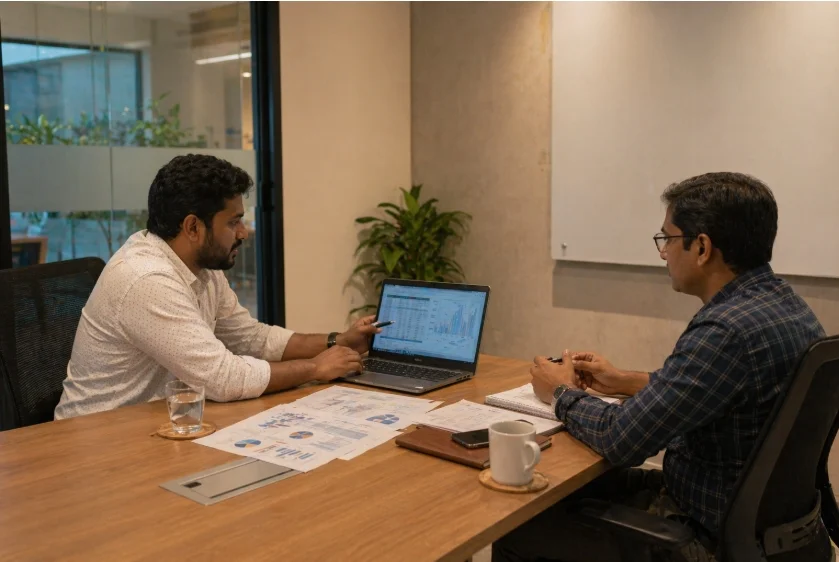
Coworking space in Ajmer for SME teams functions as a regional coordination and operations base. Sales teams manage distributor relationships and territory coverage across central Rajasthan. Operations and compliance teams handle GST filings, regulatory documentation, and vendor correspondence. Regional managers use it as a base between field visits. Client and distributor meetings happen in professional meeting rooms rather than hotel lobbies or distributor premises.
The space earns its cost through daily operational use, not just as a registered address. And for an SME that is building a regional presence in Ajmer for the first time, that combination of professional credibility and operational flexibility is difficult to replicate with a conventional lease in a market that is still maturing.
The SMEs getting into Ajmer now are not taking a risk on an unproven market. They are making a considered operational decision about where certain functions work better and cost less. That is a different kind of thinking, and it tends to produce better outcomes than defaulting to the obvious city.