

India's Banking, Financial Services and Insurance (BFSI) sector is attracting growing attention from international financial institutions, global banking groups and private equity investors. According to a Business Standard report published on 16 October 2026, global investors have committed more than $20 billion to deals across India's BFSI sector since 2025.
What makes this activity particularly interesting is the range of businesses receiving international attention. Investments are no longer limited to traditional banks. Global investors are exploring opportunities in non banking financial companies, insurance, wealth management, investment banking and financial technology.
For international investors, India represents a market with growing demand for financial products, an expanding digital infrastructure and opportunities to participate in multiple financial services segments. However, the investment decisions also reflect the commercial potential of individual institutions and their ability to manage risks.
The larger question is what is making India's financial services industry attractive to international capital and what does this growing international interest mean for Indian businesses?
What Is Driving Global Investor Interest in India?
International investments in India's financial sector are influenced by several developments that have taken place over the past decade. Rather than depending on one opportunity, investors are looking at the broader expansion of India's financial ecosystem.
Here are some of the important factors behind this interest.
Growing Demand for Financial Services
India's expanding economy is creating demand for a wider range of financial products. Businesses need working capital, individuals require access to housing and vehicle finance and organisations depend on banking services to manage everyday transactions.
As more businesses enter new markets and existing enterprises expand their operations, their financial requirements become more complex.
This creates opportunities for banks, NBFCs and other financial institutions to develop products for different customer segments.
The growing demand is also reflected in banking activity. According to RBI data reported by Business Standard, bank credit increased approximately 19.4% year on year to ₹229.95 lakh crore in the fortnight ended 30 September 2026.
Such growth indicates the scale of financing activity in the country. However, credit growth also needs to be evaluated alongside repayment capacity, asset quality and the availability of deposits.
Greater Access to Formal Financial Services
Financial inclusion has expanded the reach of banking services across urban and rural India.
Initiatives such as the Pradhan Mantri Jan Dhan Yojana have brought millions of people into the formal banking system. According to the Department of Financial Services, the scheme had approximately 59.63 crore beneficiaries as of 21 October 2026.
This wider financial access creates opportunities for financial institutions to develop services around savings, insurance, payments and responsible lending.
For international investors, a larger customer base can provide opportunities to build businesses over an extended period.
However, having a bank account does not automatically mean that every customer has access to affordable credit or suitable financial protection. Institutions still need to develop products that address different financial requirements.
Expanding Digital Financial Infrastructure
India has developed a substantial digital payments ecosystem through platforms such as UPI.
Digital infrastructure has changed how individuals and businesses transfer money, collect payments and interact with financial institutions.
For banks and financial technology companies, this creates opportunities to improve transaction processing, customer onboarding and service distribution.
International investors may see value in businesses that can use this infrastructure to reach customers efficiently while maintaining suitable security and compliance systems.
Opportunities in Insurance and Wealth Management
The Indian financial market also presents opportunities beyond lending.
Insurance remains an important area because households and businesses require financial protection against health, property, life and operational risks.
Similarly, rising financial participation is creating demand for wealth management, investment advisory and asset management services.
These businesses require specialist expertise, distribution networks and technology capabilities. International financial institutions can potentially contribute experience and resources in these areas.
Increasing Depth of India's Financial Markets
India's mutual fund industry provides another indication of the expanding financial ecosystem.
According to the Association of Mutual Funds in India, the industry's assets under management stood at approximately ₹82.64 lakh crore on 30 September 2026.
The industry has grown substantially over the past decade, creating opportunities for asset managers, investment banking firms, wealth management businesses and technology providers.
For international financial groups, the attraction lies in participating in a financial market that is becoming more diverse.
Did You Know?
India's digital payments infrastructure has reached a remarkable scale.
According to the National Payments Corporation of India (NPCI), UPI recorded approximately 25.47 billion transactions in October 2026.
This represents more than 25 billion digital payment transactions in a single month.
For global financial institutions, this scale demonstrates the importance of India's digital financial infrastructure. It also creates opportunities in payment technology, banking applications, fraud prevention and financial data services.
Why Global Investors Are Betting on India's BFSI Sector
The following infographic summarises the major factors attracting international investors, the financial segments receiving capital and the potential implications for Indian businesses.
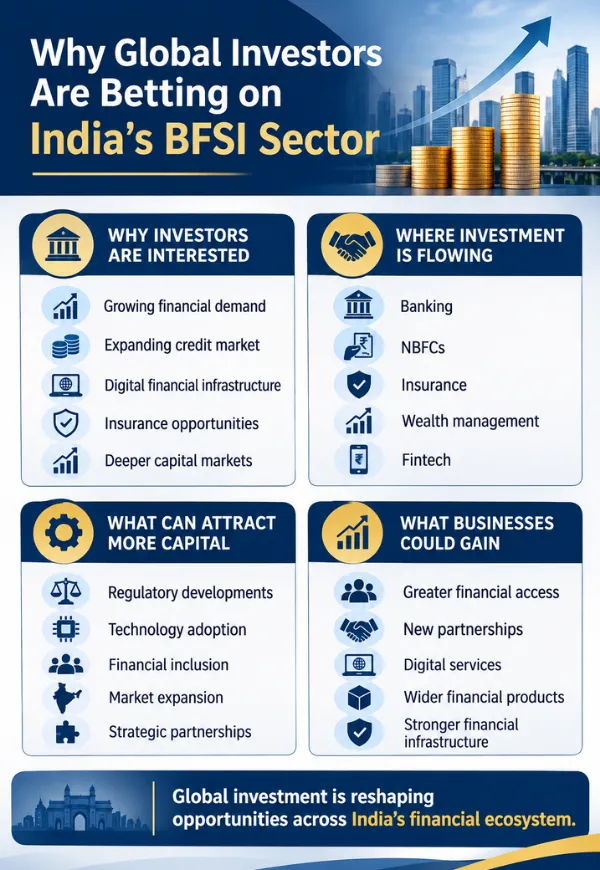
The growing investment activity is spread across several financial sectors. Understanding where this capital is going provides a clearer picture of the opportunities international investors are identifying.
Where Is Global Capital Flowing?
International investment is reaching different parts of India's BFSI industry. Each segment offers a different business opportunity and attracts investors for different reasons.
Banking
Traditional banking continues to attract considerable international attention.
Foreign banking groups may see opportunities to enter the Indian market through strategic investments, ownership changes and partnerships with established domestic institutions.
These investments can provide access to an existing customer base, banking infrastructure and local market experience.
Some important examples illustrate the scale and variety of this activity.
Fairfax Financial Holdings and IDBI Bank
One of the largest developments is the proposed acquisition of a 60.72% stake in IDBI Bank by Fairfax Financial Holdings.
On 14 October 2026, the Cabinet Committee on Economic Affairs approved Fairfax as the strategic buyer for the transaction. The purchase consideration is approximately ₹52,878 crore.
However, this must not be described as a completed acquisition.
In its 3 November 2026 financial disclosure, Fairfax India confirmed that definitive transaction agreements had not yet been signed. The transaction remains subject to several governmental, regulatory and other approvals.
The Ministry of Finance announcement provides the approved transaction structure and consideration.
Emirates NBD and RBL Bank
Another significant development involves Dubai based Emirates NBD and RBL Bank.
Unlike the IDBI Bank transaction, this investment has already been completed.
On 18 June 2026, Emirates NBD completed its acquisition of a majority stake in RBL Bank through a primary capital infusion of approximately $2.75 billion. It acquired 60% of the expanded share capital.
The official transaction announcement confirms that the investment was completed after receiving the required regulatory approvals.
The integration of Emirates NBD's Indian branches with RBL Bank has also received RBI approval and is scheduled to take effect on 1 December 2026.
This transaction demonstrates how international banking groups can establish a stronger presence in India through investments in existing domestic institutions.
SMBC and YES Bank
Japan's Sumitomo Mitsui Banking Corporation (SMBC) has also invested in YES Bank.
SMBC completed its initial acquisition of a 20% stake in September 2025. It subsequently signed an agreement to acquire an additional 4.2% stake from an affiliate of Carlyle Group.
The SMBC announcement dated 17 September 2025 confirms the completion of the initial acquisition and the agreement for the additional investment.
These developments illustrate how international banking groups are exploring strategic participation in India's private banking sector.
Non Banking Financial Companies (NBFCs)
NBFCs are another major destination for international capital.
Unlike traditional banks, NBFCs generally focus on specific financial activities such as consumer lending, vehicle finance, housing finance and business credit.
Their specialised lending models allow them to serve customer segments that may have different financing requirements from traditional bank customers.
This makes established NBFCs particularly relevant to investors looking for exposure to India's retail and business credit markets.
MUFG and Shriram Finance
Japan's Mitsubishi UFJ Financial Group (MUFG) entered into an agreement in December 2025 to acquire a 20% stake in Shriram Finance for approximately ₹39,620 crore, equivalent to around $4.4 billion at the exchange rate used in the announcement.
The investment was structured through a preferential allotment of shares.
The original MUFG announcement outlined the proposed investment and its regulatory conditions.
The Competition Commission of India subsequently approved the transaction on 25 March 2026.
On 8 April 2026, Shriram Finance approved the allotment of approximately 47.11 crore shares to MUFG for approximately ₹39,618 crore.
This makes it an important example of international capital entering India's specialised lending sector through a completed equity allotment.
International Holding Company and Sammaan Capital
Abu Dhabi based International Holding Company (IHC) has also established a presence in India's NBFC sector through its investment in Sammaan Capital.
The investment was structured through equity shares and warrants.
According to Sammaan Capital's May 2026 announcement, IHC had received an initial allotment representing a 28.5% holding after the first tranche. Further investment through warrant conversion was expected to increase its holding to 43.5%.
The transaction demonstrates how international investors may use phased capital commitments to establish a strategic position in Indian financial institutions.
Insurance
India's insurance sector presents another important opportunity for foreign investors.
Life insurance, health insurance, general insurance and reinsurance businesses require significant capital, distribution capabilities and specialised risk management.
Despite the industry's expansion, insurance penetration remains relatively low compared with the financial protection requirements of a large population.
According to a Ministry of Finance backgrounder published in April 2026, India's insurance penetration stood at 3.7% in FY 2024 to 25.
The sector collected approximately ₹11.93 lakh crore in premiums during that financial year.
These figures indicate the existing scale of the market as well as the scope for further development.
Prudential and Bharti Life Insurance
In May 2026, UK based Prudential plc announced an agreement to acquire a 75% stake in Bharti Life Insurance for an initial consideration of ₹3,500 crore.
The agreement also included additional consideration of up to ₹700 crore subject to specified conditions.
The official Prudential announcement confirmed that completion was subject to regulatory approvals.
The Competition Commission of India approved the proposed acquisition in August 2026. This is an important approval milestone, but it should not be confused with confirmation that every remaining closing condition has been fulfilled.
Mahindra and Manulife
Another development is the proposed 50:50 life insurance partnership between Mahindra and Canada's Manulife.
The companies announced their agreement in November 2025 and subsequently incorporated Mahindra Manulife Insurance Limited in June 2026 after receiving approval from the Ministry of Corporate Affairs.
The Mahindra announcement explains the intended structure of the partnership.
The venture combines Mahindra's domestic presence with Manulife's international insurance experience.
The development reflects international interest in building insurance businesses through long term partnerships rather than relying exclusively on acquisitions.
Wealth Management and Financial Technology
International investors are also exploring India's wealth management and financial technology businesses.
Growing participation in mutual funds and other investment products creates demand for advisory services, asset management, portfolio management and investment banking.
These services become particularly relevant as individuals and businesses seek more structured ways to manage financial assets.
Japan's Mizuho Financial Group, for example, entered into an agreement in December 2025 to acquire more than 60% of Avendus Capital.
The Mizuho announcement outlined the proposed transaction.
The Competition Commission of India approved the proposed acquisition in April 2026. Other regulatory clearances remained relevant to the transaction.
On the technology side, investors are interested in businesses offering digital lending platforms, payment solutions, financial data services and automated investment tools.
However, a large user base or rapidly growing transaction volume does not necessarily translate into sustainable profits. Investors also examine customer acquisition costs, regulation, operating expenses and the strength of business models.
How Regulatory Reforms Are Influencing Investor Confidence
Regulatory clarity plays an important role in determining whether international investors are willing to enter a financial market.
Financial institutions operate in a highly regulated environment. Their ownership structures, capital requirements, licences and management arrangements can influence the feasibility of an investment.
India's recent insurance reforms are particularly relevant.
100% Foreign Direct Investment in Insurance
The Sabka Bima Sabki Raksha (Amendment of Insurance Laws) Act, 2025 introduced an important change by increasing the permitted foreign investment limit in Indian insurance companies from 74% to 100%.
The reform became operational on 5 February 2026, except for Section 25 of the Act, as confirmed by the official Gazette notification dated 3 February 2026.
The government also notified the Indian Insurance Companies (Foreign Investment) Amendment Rules, 2025 on 30 December 2025.
The changes allow eligible foreign investors to hold full ownership in an Indian insurance company, subject to the applicable legal and regulatory conditions.
This can influence the insurance market in several ways.
First, international insurance groups may have greater flexibility when deciding how to structure their Indian operations.
Second, companies may find it easier to plan long term capital investments and technology development.
Third, foreign institutions may be more willing to establish new businesses or increase their participation in existing ones.
However, 100% foreign investment does not mean that insurance companies can operate without regulatory oversight. Licensing, solvency requirements, governance rules and policyholder protection obligations continue to apply.
Foreign Investment in Banking
Banking follows a different ownership framework.
According to the Department of Financial Services, foreign investment in private sector banks is permitted up to 74%.
Investment up to 49% is allowed through the automatic route. Investment beyond 49% and up to 74% requires government approval.
For public sector banks, the foreign investment limit is 20% through the government approval route.
These limits demonstrate why the rules applicable to insurance companies cannot simply be applied to banks.
Foreign banking groups also have to satisfy relevant RBI requirements and other regulatory conditions.
Foreign Investment in NBFCs and Other Financial Services
The rules for non banking financial companies and other financial services depend on the activity being undertaken and the applicable regulatory framework.
Certain regulated financial services activities permit up to 100% foreign investment through the automatic route, subject to the relevant conditions.
The DPIIT Foreign Direct Investment Policy and applicable RBI regulations provide the framework for these investments.
Unregulated activities or businesses that fall outside the relevant automatic route may require government approval.
Therefore, investors must examine the exact business activity rather than relying on a single foreign investment percentage for the entire financial sector.
Importance of Regulatory Predictability
Apart from investment limits, international investors consider several additional factors.
These include the approval process, corporate governance standards, capital adequacy requirements, management responsibilities and the regulatory treatment of financial transactions.
The involvement of authorities such as RBI, SEBI, IRDAI and the Competition Commission of India can influence the timing and structure of an acquisition.
Greater clarity can make investment planning easier. At the same time, appropriate regulatory oversight remains essential for protecting depositors, investors and policyholders.
Why Digital Finance Is Important to Global Investors
India's digital financial infrastructure has become an important consideration for international financial institutions.
The opportunity is not limited to digital payments. It extends across the entire customer journey, from opening an account to applying for credit and managing investments.
Digital Payments
UPI has become a major part of everyday financial activity.
Its large transaction volumes create opportunities for payment processing, merchant services, fraud detection and digital financial products.
Financial institutions can use payment data and customer relationships to develop more relevant services, subject to applicable consent and data protection requirements.
Digital Lending
Technology has changed how financial institutions assess applications, process documents and manage loan accounts.
Digital onboarding and automated credit assessment can help lenders reduce processing time and serve customers across different markets.
However, lenders still need appropriate credit evaluation systems. Faster loan processing does not eliminate the possibility of defaults.
Responsible lending practices and transparent customer communication remain important.
Digital Insurance Distribution
Insurance companies are increasingly exploring digital channels for policy discovery, customer onboarding, premium payments and service management.
Online distribution can help insurers reach customers who may not regularly interact with traditional insurance agents.
However, certain customers continue to require face to face assistance when selecting products or understanding policy conditions.
Wealth Management Technology
Digital investment platforms have made financial products easier to access for a wider customer base.
Investors can use technology to track portfolios, access market information and manage investments.
For financial companies, this creates opportunities to develop better customer interfaces and more efficient advisory services.
Account Aggregation and Financial Data
India's Account Aggregator framework allows individuals and businesses to share financial information between regulated institutions through consent based mechanisms.
This creates opportunities for lenders and other financial institutions to assess customer information more efficiently.
When combined with suitable data security and consent arrangements, financial data infrastructure can improve service delivery.
Artificial Intelligence and Automation
Financial institutions are also examining how artificial intelligence can support customer service, risk monitoring, fraud identification and operational processes.
However, technology adoption requires investment in cybersecurity, data governance and employee capabilities.
Digital services may reduce the need for certain manual activities but they do not eliminate the importance of physical branches, customer support teams and relationship management.
Different customer groups continue to require different service channels.
What Foreign Investment Could Mean for Indian Businesses and Customers
International investment can influence the financial services market beyond the institutions directly receiving capital.
Its potential impact depends on how financial companies use their additional resources and expertise.
Greater Financial Capacity
Investments in banks and NBFCs can strengthen their capital position.
This may provide institutions with additional capacity to support lending activities, invest in technology and expand into new customer segments.
For businesses, stronger financial institutions could create more opportunities to explore different financing arrangements.
However, lending decisions will continue to depend on the borrower's financial position, creditworthiness and the lender's risk assessment.
Greater Competition
When international financial institutions enter the market, domestic financial companies may face additional competition.
This can encourage institutions to examine their products, operating processes and customer experience.
Over time, competition may encourage greater product variety and service improvements.
However, there is no guarantee that every new investment will result in lower borrowing costs or better customer service.
Access to International Expertise
International investors may contribute experience in areas such as risk management, investment banking, financial technology and institutional lending.
Domestic financial companies can potentially benefit from this expertise through management participation, technology investments and knowledge sharing.
The actual benefits depend on how successfully the organisations integrate their capabilities.
Wider Financial Products
A growing financial ecosystem can create opportunities for new products in insurance, investment management and business lending.
For small and medium sized businesses, this may mean access to a broader range of financial services.
For individuals, it could create more choices in savings, protection and investment products.
The suitability of these products will continue to depend on customer requirements and financial circumstances.
Opportunities and Risks for the BFSI Industry
The growing interest of international investors presents opportunities for the industry. However, the financial sector also comes with risks that cannot be ignored.
Opportunities
Market expansion: Financial institutions can explore new customer segments and extend their services into additional geographical markets.
Technology development: Additional investment can support digital banking, cybersecurity, automation and improved financial infrastructure.
Capital availability: Stronger capital positions can support responsible lending and long term business development.
Financial inclusion: Better distribution and suitable financial products may help reach customers who have limited access to formal financial services.
Strategic partnerships: Domestic companies can gain access to international expertise and established financial networks.
Product innovation: Competition and new capabilities may encourage the development of products suited to changing customer needs.
Risks
Regulatory uncertainty: Changes in regulatory requirements or delays in approvals can influence investment timelines.
Asset quality: Banks and NBFCs need to manage loan defaults and maintain appropriate lending standards.
Cybersecurity: Greater dependence on digital infrastructure increases the importance of protecting financial systems and customer information.
Data privacy: Financial institutions must handle sensitive customer information responsibly and follow applicable laws.
Governance: Changes in ownership and management need to be supported by transparent decision making and strong internal controls.
Integration challenges: Acquisitions may involve differences in technology systems, organisational practices and operating processes.
Valuation risks: A high acquisition price does not guarantee that an investor will achieve the expected returns.
Global economic uncertainty: Interest rate changes, currency movements and international financial conditions can influence investment decisions.
These considerations explain why international investors evaluate both market potential and the ability of individual institutions to manage risk.
A large financial market can offer significant opportunities, but the quality of the investment remains equally important.
A Practical Business Scenario: How Investment Can Influence Financial Services
Consider a growing financial services company that provides loans to small businesses and vehicle owners.
As the company expands, it may need additional capital to strengthen its lending operations and reach new customer groups.
An international investor enters the business through a strategic equity investment.
The additional capital could help the company improve its technology systems, strengthen its risk management capabilities and develop a wider distribution network.
It may also allow the institution to invest in customer service and operational infrastructure.
Over time, these improvements could make it easier for eligible customers to access its financial products.
Small businesses using the lender's services may benefit from more accessible application processes and a wider range of financing options.
However, these improvements are not automatic. The company must maintain responsible lending practices, manage repayment risks and use its additional resources effectively.
This example illustrates how investment into one financial institution can have potential implications for the businesses and individuals that depend on its services.
What This Could Mean for the Wider Business Ecosystem
The expansion of India's BFSI sector can create opportunities for businesses outside traditional banking and financial services.
As financial institutions grow, their operational requirements also become more extensive.
Technology and Cybersecurity Businesses
Banks, insurers and fintech companies depend on technology infrastructure to process transactions, manage customer information and protect financial systems.
This creates demand for IT services, cloud infrastructure, software development and cybersecurity solutions.
Data Analytics and Compliance Services
Financial institutions require specialist capabilities to analyse customer information, monitor transactions and comply with regulatory requirements.
Businesses providing data analytics, audit support and compliance technology may find opportunities in this environment.
Recruitment and Professional Services
An expanding financial services company may need additional employees across banking operations, risk management, finance, technology, legal functions and customer service.
This can create opportunities for recruitment companies, training providers and professional service firms.
Business Process Services
Financial institutions often depend on specialised teams to manage customer support, documentation, transaction processing and back office functions.
As operations grow, businesses providing outsourcing and process management services may become important partners.
Commercial Infrastructure and Workplace Requirements
The expansion of banks, NBFCs, insurance companies and fintech businesses can also influence demand for physical business infrastructure.
Financial institutions may require regional offices, technology centres, customer service operations, training facilities and dedicated client meeting areas.
For companies expanding into new markets, choosing suitable commercial office space can become an important operational decision.
Some organisations may prefer a serviced office when establishing a regional presence without immediately developing a large permanent facility.
Businesses handling confidential financial information or client discussions may also require a dedicated private office for their teams.
The exact requirement depends on the company's scale, location, operational structure and customer service model.
This is one example of how the growth of a financial sector can create demand across a wider network of business services and infrastructure providers.
What Founders and Business Leaders Should Watch
The increasing international interest in India's financial sector offers several developments that business leaders should monitor.
Rather than focusing only on investment announcements, companies should examine what is changing in the market and how those developments could influence their operations.
Some useful questions include:
Which financial services segments are receiving the most investment?
Look at whether capital is going towards traditional banking, NBFCs, insurance, wealth management or digital finance.
Are announced investments actually being completed?
Check whether a transaction has received regulatory approval, completed its capital infusion or remains at the agreement stage.
Are financing options changing?
Monitor developments in business lending, working capital facilities and other financial products.
How is digital finance influencing business operations?
Examine whether financial institutions are improving payment collection, digital onboarding and financial reporting services.
Are new financial partnerships emerging?
International investment can create opportunities for technology providers, consultants and specialist financial service businesses.
How are financial institutions expanding geographically?
Regional expansion may create opportunities for businesses operating in local markets, particularly those providing technology, professional and operational support.
These questions can help decision makers understand the wider implications of BFSI investment rather than relying only on headline figures.
Practical Takeaways for Business Leaders
The increasing investment activity across India's BFSI sector offers several lessons for businesses.
-
Track completed investments rather than depending only on announcements and proposed acquisitions.
-
Understand which financial services segments are attracting the most international capital.
-
Monitor regulatory changes affecting banking, insurance and NBFCs.
-
Evaluate financial partnerships based on actual business requirements.
-
Explore opportunities arising from digital payment and financial data infrastructure.
-
Monitor changes in lending conditions and the availability of business credit.
-
Examine insurance products that may support business continuity and risk management.
-
Understand how financial technology can improve operational efficiency.
-
Assess the credibility and regulatory standing of financial service providers.
-
Do not assume that higher foreign investment automatically results in cheaper borrowing or better financial returns.
Closing Reflection
The increasing international interest in India's BFSI sector reflects a broader change in how global financial institutions view the country's financial ecosystem.
The opportunity extends beyond traditional banking. Lending, insurance, wealth management, investment banking and financial technology are becoming important parts of the investment conversation.
The reported $20 billion plus activity since 2025 highlights the scale of this interest. However, the underlying transaction structures matter just as much as the headline figure. Some investments have been completed while others remain subject to approvals or future capital commitments.
For Indian businesses, the more important development is the potential impact on financial access, institutional capabilities, technology and the wider network of services supporting the economy.
The long term significance of this investment activity will depend on whether financial institutions can convert additional capital and international expertise into sustainable operations, responsible lending and useful financial services.
India's financial ecosystem is attracting international attention, but its ability to deliver lasting business value will ultimately depend on the quality of its institutions and the strength of the opportunities they create.
Frequently Asked Questions
Why are global investors interested in India's BFSI sector? +
Global investors are attracted by India's expanding demand for financial products, growing credit requirements and developing digital infrastructure. Opportunities in banking, insurance, wealth management and financial technology also provide different ways to participate in the market.
What is attracting foreign investment into Indian banks and NBFCs? +
Investors are interested in the expanding lending market, established domestic customer networks and opportunities to strengthen financial institutions through capital and technology. The investments of MUFG in Shriram Finance and Emirates NBD in RBL Bank demonstrate the range of opportunities in this segment.
Which areas of India's financial services industry are receiving international investment? +
International investment is reaching traditional banks, NBFCs, insurance companies, investment banking businesses and wealth management firms. Financial technology and digital financial services are also attracting attention.
How do foreign investments benefit India's banking and insurance sectors? +
Foreign investment can provide additional capital, international expertise and access to technology. It may also encourage competition and support the development of financial products. However, the actual benefits depend on how effectively institutions use the investment.
What does 100% FDI in the insurance sector mean for India? +
It means eligible foreign investors can hold up to 100% ownership in an Indian insurance company under the applicable regulatory framework. The provision under the Sabka Bima Sabki Raksha Act, 2025 became effective on 5 February 2026, subject to the prescribed conditions and continued regulatory oversight. The reform can provide greater flexibility for international insurance groups considering acquisitions, new businesses or additional capital investment.
How is digital finance influencing international investment in India? +
India's digital payment infrastructure, digital banking services and consent based financial data systems create opportunities for technology driven financial businesses. Investors are examining how these capabilities can improve customer access, operational efficiency and financial distribution. However, technology adoption still requires investment in security, compliance and customer support.
What are the major risks associated with foreign investment in India's financial sector? +
Major risks include regulatory changes, asset quality concerns, cybersecurity threats, data privacy issues and valuation challenges. Investors must also consider governance standards and the integration of different business operations. Higher market demand does not necessarily guarantee successful investments or strong financial returns.