
Expansion Strategies Are Being Quietly Rewritten
Satellite offices are no longer temporary structures used for market trials or overflow teams. By 2026, they are becoming deliberate, structured layers in multi-city operating models.
Businesses aren’t moving away from Tier 1 cities.
They’re building beyond them.
What’s driving this shift is not preference, but alignment. Demand is no longer concentrated only in startup-heavy business districts. It is moving closer to where India actually produces, learns, and delivers services—a pattern Tier 2 cities fit far more naturally.
This shift mirrors the broader trend discussed in From Metros to Momentum: The Rise of Satellite Offices in India, where satellite expansion is no longer reactive—it’s strategic.
What a “Satellite Office” Really Means Today
In 2026, satellite offices are not smaller headquarters.
They are focused, operational setups built for specific teams like sales, operations, support, project delivery, or regional functions. These offices are designed to be deployed quickly, scaled up flexibly, and continuously adapted to changing business needs.
Permanence is no longer the goal. This shift in definition explains why Tier 2 cities are becoming the default choice for satellite teams.
Why Tier 1 Cities Are Not the Automatic Choice Anymore
Tier 1 cities remain critical for leadership presence, client strategy, and brand positioning. However, they are increasingly inefficient bases for satellite teams.
- Increasing rentals and fit-out costs make even small offices capital-intensive.
- Setup timelines stretch due to approvals and construction dependencies.
- Employee churn and long commutes silently drain productivity.
For many businesses, committing to long-term infrastructure in Tier 1 cities for non-core teams is no longer expansion—it’s overcommitment.
The Tier 2 Advantage Is Structural, Not Cyclical
Tier 2 cities work because they align with how demand is actually forming.
Economic activity is spreading across manufacturing belts, education clusters, healthcare hubs, and logistics corridors. These ecosystems generate steady, non-speculative demand — very different from startup-only micro-markets.
This structural shift delivers measurable benefits:
- More predictable expansion costs
- Faster setup timelines (often weeks, not months)
- Higher talent stability in operational roles
- Access to regional hiring without Tier 1 cost pressure
This alignment between cost, speed, and workforce stability is increasingly reflected in what growing teams prioritize: flexibility, predictability, and execution efficiency — trends also explored in What Indian SMEs Want in 2026: Top Coworking and Workspace Priorities.
Together, these forces are making Tier 2 cities more efficient hubs for satellite operations.
Which Teams Are Moving First
- Sales and distribution teams are moving closer to the market.
- Operations teams are relocating to cities with more stable hiring and lower turnover.
- Project-based delivery teams are expanding into Tier 2 cities without long-term lock-ins.
“Even Global Capability Centers are opening satellite GCCs in non-Tier 1 cities to access new talent pools.”
The offices in Tier 2 cities are not temporary. They are becoming permanent layers in multi-city operating models.
Why Flexible and Managed Offices Are Accelerating the Shift
This transition would be far slower without flexible infrastructure.
During early expansion phases, businesses are increasingly avoiding long-term leases. Headcount plans remain fluid, and growth rarely follows a straight line.
Managed offices reduce execution friction by handling setup, compliance, and day-to-day operations.
In many cases, virtual or compliant presence comes first, followed by physical teams once operations stabilize. This layered approach keeps expansion momentum intact without forcing premature commitments.
What This Means for Expansion Planning in 2026
The most important shift is conceptual.
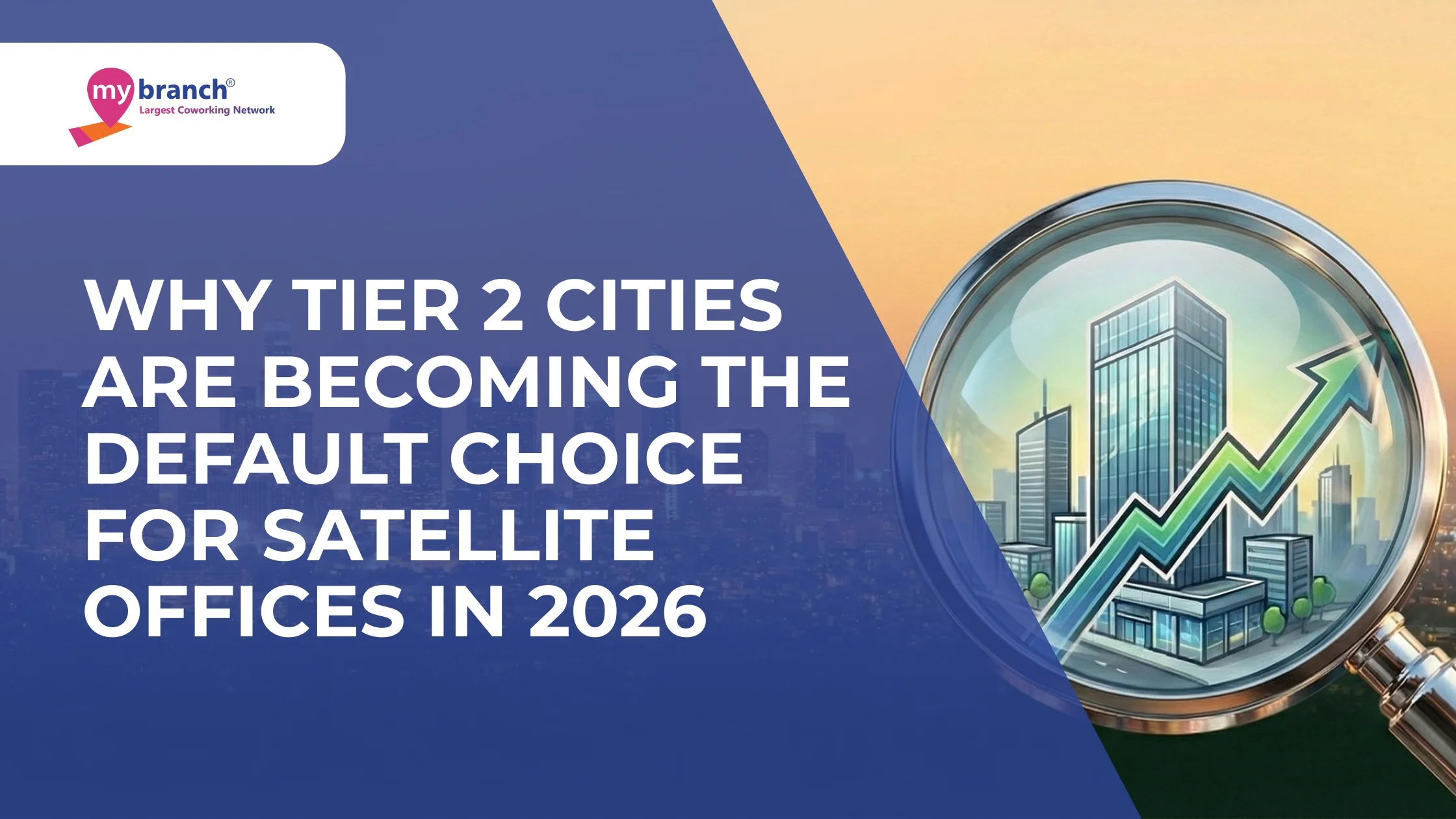
Tier 2 cities are no longer fallback options. They are becoming the default because they align with how businesses actually grow today: incrementally, regionally, and under constant uncertainty.
Satellite offices are no longer experiments.
They are part of the operating system.
In early- and mid-stage expansion, flexibility consistently outperforms ownership. Offices that adapt as fast as the business create momentum. Those that don’t quietly slow it down.
Default Doesn’t Mean Second-Best
Tier 2 cities are not a compromise.
They are becoming the default because they solve real problems — cost pressure, speed, talent stability, and regional reach — without forcing businesses into premature commitments.
In 2026, the smarter expansion question isn’t “Which metro next?”
It’s: “Where does this team work best?”