
Here’s a question more expansion heads are quietly asking themselves: “Why are we still defaulting to the same three cities?”
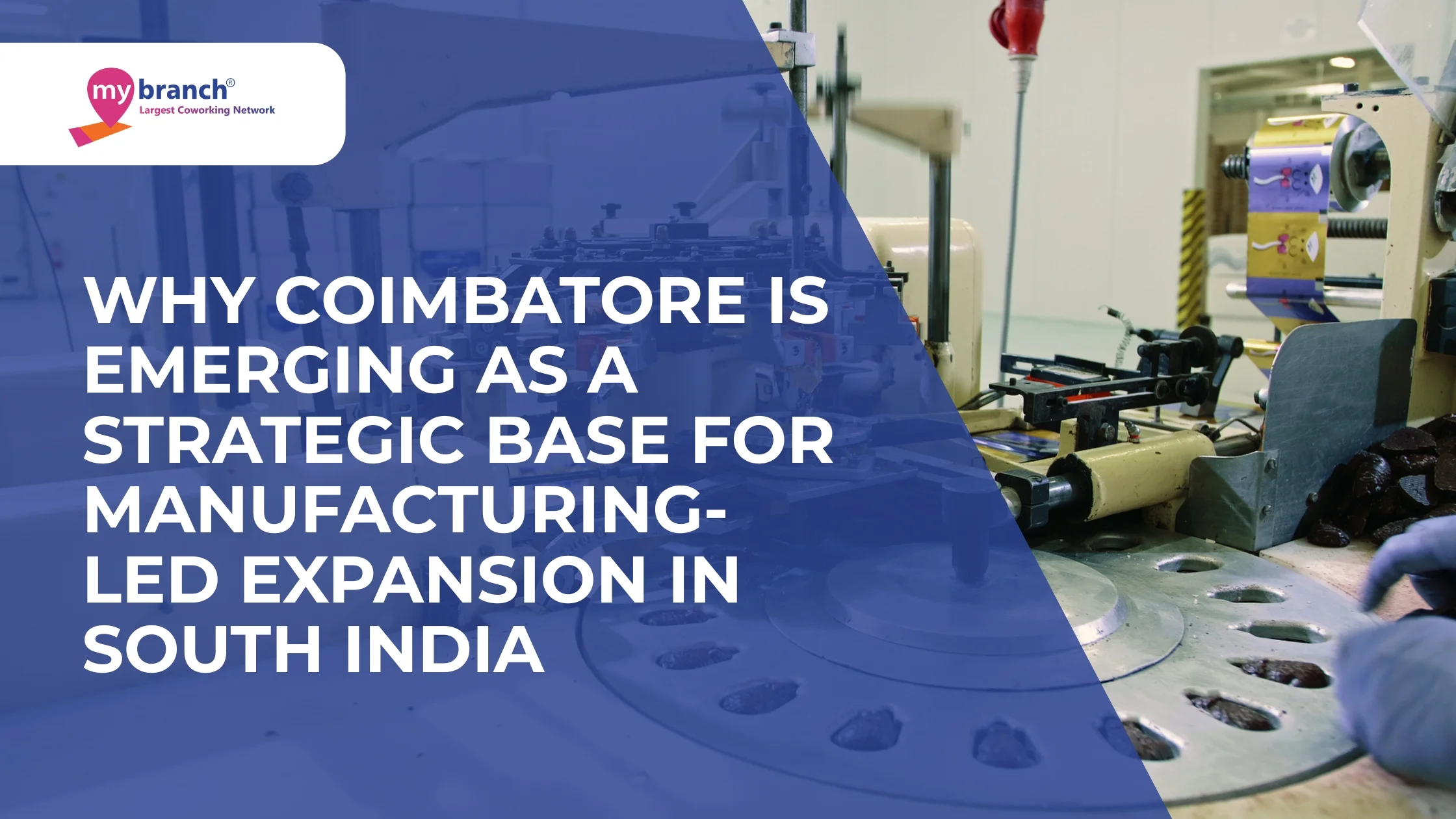
Bengaluru, Chennai, and Hyderabad are serious cities, no argument there. But when you’re running a manufacturing operation or an auto-component firm, the city that looks good on a slide isn’t always the city that makes your operations run smoothly. Coimbatore keeps coming up in those conversations, not as a fallback or a cost-cutting move, but as a genuinely strategic choice for founders and COOs asking sharper questions about where their teams actually need to be.
Expansion Is Moving Closer to Production Ecosystems
For much of the last two decades, expansion meant chasing metro visibility, talent density, investor proximity, and the gravitational pull of large cities. That still holds for some functions. But manufacturing-led businesses are increasingly asking a different question: not where should we be seen, but where can we function best? For firms in engineering, auto components, and industrial equipment, the answer is pointing toward cities structurally embedded in production ecosystems. Coimbatore is one of them.
Manufacturing Firms Expand Differently
A software company opening a new office needs a good building and a talent pool. Manufacturing firms need something harder to find: supply chain proximity, vendor ecosystems, and a technical workforce that stays. Prestige of address barely registers. Proximity to the production cluster is non-negotiable. Coimbatore has been one of South India’s anchor points for industrial activity long enough that these advantages aren’t manufactured; they’re just there.
The Structural Advantage of Coimbatore
Coimbatore’s industrial base spans engineering, auto components, textile machinery, and pumps, with hundreds of SMEs supplying OEMs and Tier-1 vendors across South and West India. That network took decades to build and creates real value for any firm looking to source, coordinate, or expand within it. The city is also well-connected to Chennai, Bengaluru, and Kochi, making regional coordination practical for teams that need to move between sites. Add a dense pipeline of polytechnic and engineering graduates technically grounded and far less transient than metro talent pools, and you have an ecosystem that supports operational expansion not just in theory, but in practice.
Why Metros Don’t Always Work for Operational Teams
Metro cities are great strategic hubs. They’re often poor operational ones. Rising real estate costs, relentless talent churn, and two-hour commutes quietly erode team output in ways that rarely show up on a spreadsheet. For procurement heads or quality engineers who need to be effective in the field, not visible in a CBD, the metro premium is genuinely hard to justify. The smarter architecture tends to be layered: metros for leadership, investor relations, and key accounts; structured regional bases for the operational functions that actually drive delivery.
A Broader Pattern Across South India
Coimbatore isn't an isolated case. Across South India, structured Tier-2 cities are earning serious attention from businesses that have outgrown the metro-first default. The pattern is consistent: firms that need operational depth, not just visibility, are finding that cities with genuine industrial or institutional ecosystems serve them better than prestigious addresses.
It's happening in manufacturing hubs, and it's equally visible in the GCC space. Cities like Visakhapatnam are attracting Global Capability Centers for the same underlying reasons: stability, cost alignment, and a workforce that isn't constantly looking for the next offer.
Read more: Why GCCs Are Increasingly Looking at Visakhapatnam for Their Next Phase of Expansion
Which Teams Move First
Regional expansion into Coimbatore typically starts with the teams closest to the ground: sales teams covering Tamil Nadu and Kerala manufacturing clusters, procurement and vendor coordination teams managing supplier relationships, quality control functions needing source proximity, and project delivery support for EPC or capital equipment work across western Tamil Nadu. These aren’t satellite roles in the secondary sense; they’re the operational core that makes the wider business function.
How Flexible Workspaces Fit In
For firms entering Coimbatore for the first time, conventional leases create unnecessary friction, long lock-ins, upfront fit-out costs, and uncertainty around team size. Flexible and managed workspaces reduce that risk considerably: teams can be operational within weeks; capital isn’t committed to a five-year lease, and seat count can scale as the function stabilizes. It’s not a compromise; it’s just a smarter way to enter a new market without betting the whole setup on a day-one projection.
Default Doesn’t Mean Secondary
Coimbatore isn’t showing up in expansion conversations because it’s cheap. It’s showing up because it’s structurally aligned with how manufacturing businesses actually scale: vendor proximity, technical workforce depth, operational cost predictability, and regional connectivity. Firms choosing it aren’t compromising on their metro strategy. They’re adding a layer that makes the whole operating model work better. That’s not a Tier-2 consolation prize. That’s just good operational thinking.
The smarter expansion question today isn’t “Which metro next?” It’s “Where does this function operate best?”